NASDAQ: TSLA / Tesla Optimus
Tesla Optimus and robot cosmetics supply chain analysis
Serenity’s social media opinion connects the scale of TSLA Optimus and the “robot appearance/skin bottleneck”. The investment judgment needs to focus on Optimus production capacity, customer verification and unit economics as the main driver. Appearance customization is a second-order variable.
Company Profile / Company Profile
Tesla is still a company with cars, energy storage and services as its financial base, and Optimus is an AI/robotics option. For TSLA, the key to the robot thesis is its ability to transfer autonomous driving, vision models, hardware manufacturing and global service networks to humanoid robots.
| Dimensions | facts | investment implications |
|---|---|---|
| Company positioning | Tesla is an electric vehicle, energy storage, service and AI/robotics platform company; Optimus belongs to the Tesla AI system.Tesla AI2025 10-K | Current profits still mainly come from the automotive and energy businesses, and robots are an option-based growth layer. |
| Optimus Definition | Tesla officials describe Optimus as a general-purpose, bipedal, autonomous humanoid robot targeted at tasks including unsafe, repetitive or tedious tasks.Tesla AI | This is not the same level of variables as “robot cosmetics” in social media; the former is functional labor substitution, and the latter is appearance and interaction acceptance. |
| Mass production path | Tesla Q1 2026 Update revealed that the first-generation large-scale Optimus factory is ready to start in Q2, with the Fremont line designed to produce 1 million units per year, and the Texas second-generation line targeting a long-term annual production capacity of 10 million units.Q1 2026 Update | This provides social media thesis with official production capacity narrative support; sales, costs, yields and customer demand have not yet been equally confirmed. |
China Competitors / China Competitors and Substitutions
TSLA is a non-Chinese standard, and the substitution analysis must be broken into modules. China has no complete substitute for Tesla's entire company's business; Chinese manufacturers have formed strong partial substitutes in terms of humanoid robot hardware, low-cost complete machines, industrial scene pilots, and bionic appearance.
| Company/Module | evidence | substitute judgment |
|---|---|---|
| Unitree Yushu Technology | Unitree’s official website displays humanoid robots such as R1/G1/H1/H2 and related components.Unitree R1 | It forms a partial substitute in low-cost display, motion control and product rhythm; it is still different from Tesla's end-to-end autonomous driving data, car-standard manufacturing system and capital scale. |
| UBTECH UBTECH | UBTECH Walker S2’s public release stated that orders for the Walker series exceeded 800 million yuan, and disclosed the progress of mass production and delivery of industrial humanoid robots.UBTECH releaseUBTECH 2025 AR | UBTECH has a more direct reading on the demand for "appearance/skin/companion robots" in social media; the replacement of Tesla is mainly in China's industrial and consumer scenarios and does not constitute a complete replacement. |
| AGIBOT Zhiyuan Robot | AGIBOT officially announced that the 15,000th robot was offline on June 28, 2026, and emphasized the move from product verification to large-scale delivery.AGIBOT | This shows that China's supply chain has formed strong competition in batch manufacturing and scenario deployment. It also undermines the credibility of linear extrapolation of the Optimus capacity narrative to Tesla-exclusive earnings. |
| alternative conclusion | China has strong partial substitutes, especially in terms of hardware cost, complete machine display, industrial customer pilot, bionic appearance and supply chain speed. A complete replacement has not yet been established because Tesla’s core variables also include autonomous driving/AI training, mass production manufacturing, software stack, capital investment, and global brand channels. | For TSLA, Chinese competition is both a valuation constraint and a demand verification. If Chinese manufacturers first bring low-priced humanoid robots and appearance customization to scale, Tesla's appearance premium will be compressed. |
Executive Summary / executive summary
Conclusion: TSLA’s investable dispute is not about “whether the robot should be good-looking” itself, but whether Optimus can transform its official production line design capabilities into a marketable, maintainable, and replicable robot business. If appearance/skin materials become a demand bottleneck, the first impact will be on acceptance, BOM, and accessory ecology; it will only directly enter TSLA valuation when Tesla captures customization revenue.
| Project | current reading | Source/Explanation |
|---|---|---|
| Stock price/market capitalization | Closing at $420.60; rough market value is about $1.58tn | Prices come from Yahoo charts; market capitalization is roughly calculated using the 2026-01-23 share capital disclosed in the 2025 10-K.Yahoo10-K |
| Liquidity | Q1 2026 cash + short-term investment is about $44.74bn | Tesla can afford to invest in AI/Optimus, but capex will continue to rise.SEC facts |
| main catalyst | Optimus production line preparation, Q2 delivery, Q2 financial report, customer/factory deployment data | Q1 Update has given the production line narrative, and subsequent verification of physical output is required.Q1 Update |
| point of view | Observation/Conditional Bullish | Robot options at current valuations will only become more supportive after continued validation of Optimus production, cost, reliability, and customer demand. |
Key Takeaways / Core Points
- The main driver is Optimus volume production and unit economics. The appearance/skin bottleneck may exist, but it can only be tracked as a second-order variable.
- Tesla's officially disclosed 1 million/10 million unit production line design capability is the strongest evidence; sales volume, yield, cost and customers have not yet been equally disclosed.
- Q1 2026 cash + short-term investment is about $44.74bn, which is enough to support the high investment period; Q1 net profit is only $0.48bn, indicating that the current valuation obviously relies on forward AI/robot options.
- Chinese manufacturers iterate quickly on hardware, low cost, bionic appearance and mass delivery, constraining Tesla's hardware premium.
- The robot cosmetics thesis in social media is more suitable as a supply chain watch list: skin materials, tactile sensing, facial expression, wigs/appearance parts, cleaning maintenance and after-sales accessories.
Recent Two-Year Share Price Trend / Stock price trend in the past two years
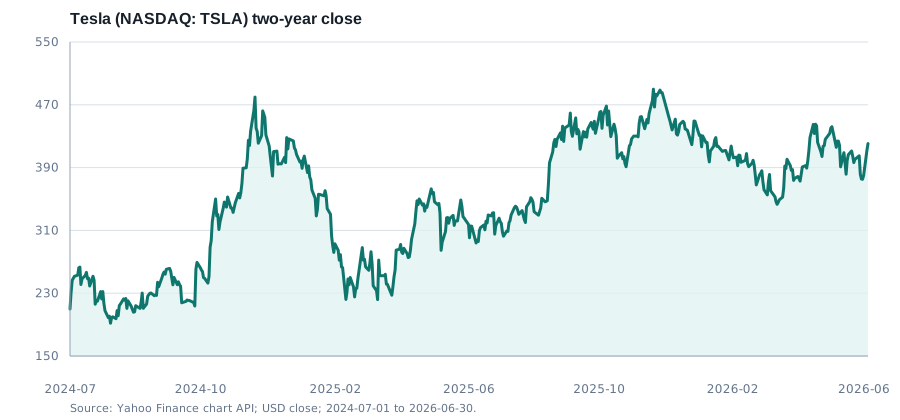
The two-year trend shows that TSLA has risen from about $210 in mid-2024 to $420.60 on 2026-06-30. Price changes suggest the market has priced in AI, Robotaxi and Optimus options; the new robot cosmetics narrative needs real output data to continue to drive reratings.
Market Context/Industry Background
Humanoid robot market forecasts vary widely. Goldman Sachs has discussed that the global robot market will reach tens of billions of dollars by 2035, and Morgan Stanley has given a longer-term and higher scenario forecast for the potential market for humanoid robots in 2050.Goldman SachsMorgan Stanley
What these predictions have in common is that real value comes from labor substitution, automation of manufacturing and service scenarios, software/ops revenue, and replicable low-failure deployments. Appearance and skin materials will affect consumer and public scene acceptance, but cannot replace reliable labor ability.
Company / Segment Quality / Business Quality
| business layer | quality judgment | Relation to Optimus thesis |
|---|---|---|
| car | Mature revenue and cash flow base, but competition and pricing pressure persist. | AI/Optimus inputs are funded while current margins determine how many forwards the market can bear. |
| energy | Energy storage deployment Q1 2026 reached 8.8 GWh.Tesla deliveries | Energy growth improves revenue diversification but is weakly associated with robotic appearance thesis. |
| AI / Robotaxi | Software, data, chips, and reasoning power are at the heart of Tesla’s AI narrative. | If robotaxi and FSD deliver, investors will be more likely to trust Optimus' software migration. |
| Optimus | Official disclosure of large-scale production line design goals; commercialization data is insufficient. | Core options. Appearance/skin materials will only become a real income layer after the scale and usage scenarios are clear. |
Company-Specific Evidence / Company Evidence
| evidence | facts | judge |
|---|---|---|
| Q1 Delivery and Energy Deployment | Tesla Q1 2026 produces over 408k units, delivers over 358k units, and deploys 8.8 GWh of energy storage.Tesla deliveries | Cars remain a cash flow base; Optimus' capital investment must be covered by its existing business and balance sheet. |
| cash and investments | Q1 2026 cash, cash equivalents and short-term investments totaled approximately $44.74bn.SEC facts10-Q | This provides a cushion for AI, semiconductor and Optimus manufacturing expansion. |
| Robot production line | Q1 2026 Update disclosed that the Fremont first-generation Optimus line is designed for 1 million units/year, and the Texas second-generation line is targeted for long-term 10 million units/year.Q1 2026 Update | This is the most important official evidence; it still needs to be verified later with equipment installation, yield, output, customer and unit economics. |
| Social Media Appearance Variables | UBTECH U1 Discussions with robot cosmetics reveal that look, feel, materials, personification and customization may influence consumer acceptance.Trigger X posts | This variable is currently a second-order variable. In the absence of Tesla's official product specifications, BOM, suppliers and selling prices, it cannot be directly included in TSLA revenue. |
Competitor Landscape / competitive landscape
| company | Status | Mass production/product evidence | Strengths | What it means for TSLA |
|---|---|---|---|---|
| Tesla Optimus | Internal projects of US listed companies | Official disclosure of 1 million/10 million unit production line design; mass production sales volume not disclosed | AI/autonomy, manufacturing, capital, brand | Current valuations already include AI/robot options significantly |
| Unitree | Chinese unlisted robotics company | R1/G1/H series public display and sales channels | Low cost, fast speed and strong motion control | Substitution pressure mainly comes from hardware cost performance and product iterations |
| UBTECH | HK:09880 | Walker series order and delivery disclosure; U1 related requirements to enhance appearance/accompanying scenes | Industrial customers, bionic appearance, Hong Kong listing financing channels | Closer to the robot cosmetics theme, but different from the Tesla AI stack |
| AGIBOT | Not listed | Official disclosure of 15,000 units offline milestone | Supply chain organization and rapid mass production | Proves China’s mass production speed and suppresses Tesla’s exclusive narrative |
Financial Statement Analysis/Financial Statement
Financial analysis based on Tesla 2025 10-K, Q1 2026 10-Q, and SEC companyfacts. All amounts are in U.S. dollars.2025 10-KQ1 10-QSEC facts
| indicator | FY2025 | Q1 2026 | pronunciation |
|---|---|---|---|
| income | $94.8bn | $22.4bn | Q1 is still dominated by automobiles, energy, and services; Optimus has not yet become a separate income item.SEC facts |
| gross profit | $17.1bn | $4.7bn | If the robot enters the manufacturing stage, the early gross profit margin may be dragged down by yield rate and depreciation.10-Q |
| operating profit | $4.4bn | $0.9bn | When R&D and AI manufacturing inputs rise, short-term profit margins may conflict with long-term option value.SEC facts |
| net profit | $3.8bn | $0.5bn | At a rough market cap of ~$1.58tn, the static multiple to 2025 net profits is over 400x; the market is clearly pricing options beyond autos.2025 10-KYahoo chart |
| Operating cash flow / Capex | $14.7bn / $8.5bn | $3.9bn / $2.5bn | Q1 free cash flow is approximately $1.44bn; Optimus factory expansion will continue to tie up capital.SEC facts |
Forecast / Operating Bridge / Forecast Bridge
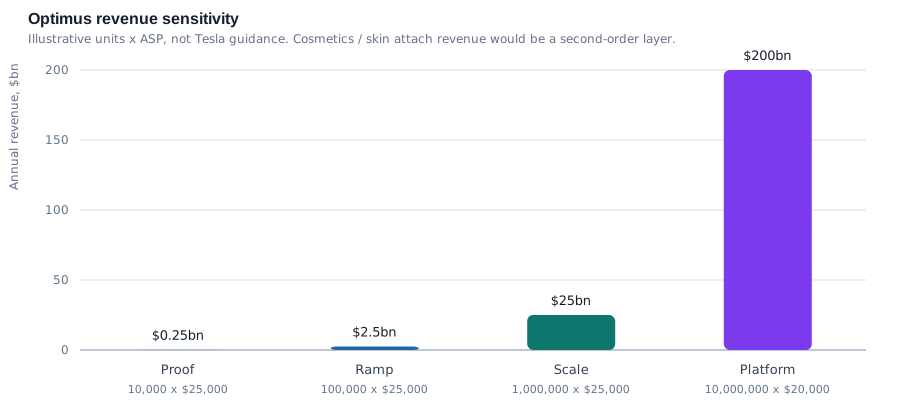
The table below is a schematic calculation, not a Tesla guideline. It serves to illustrate why Optimus must reach the million-dollar revenue tier before it can materially change TSLA's financial structure.
| Scenario | hypothesis | annual income | explain |
|---|---|---|---|
| Proof | 10,000 units x $25,000 ASP | $0.25bn | The impact on Tesla's existing revenue will be minimal and will mainly be product validation. |
| Ramp | 100,000 units x $25,000 ASP | $2.5bn | It has entered the visible income layer, but it is still difficult to explain the current market value premium. |
| Scale | 1,000,000 units x $25,000 ASP | $25bn | It begins to affect the company's revenue structure; it requires the production line, supply chain, customer and service systems to be established at the same time. |
| Platform | 10,000,000 units x $20,000 ASP | $200bn | Enough to change Tesla's revenue curve; this is a high-uncertainty forward scenario, not the company's short-term guidance. |
Valuation / valuation
Using a rough calculation of the 2026-06-30 closing price of $420.60 and the 2026-01-23 common stock disclosed in the 2025 10-K, TSLA has a market value of approximately $1.58tn.Yahoo chart2025 10-K
Corresponding to FY2025 net profit of $3.79bn, the static multiple exceeds 400x; corresponding to Q1 2026 annualized net profit, the multiple is even higher. This valuation structure suggests that auto and energy margins are just the base, and the market has given heavy weight to AI, Robotaxi, and Optimus forward options.
| valuation layer | Conditions required | Current quality of evidence |
|---|---|---|
| Car + energy base | Revenue is stable, gross profit margin no longer deteriorates, and cash flow remains positive | SEC financials are verifiable, and growth and margins still need to be tracked quarterly. |
| AI/Robotaxi | Supervision, accident rate, unit economics, scale deployment | There has been more public progress, but business closure is still the key variable. |
| Optimus | Production line, yield, reliability, customers, selling price, service revenue | Q1 Update provides capacity design targets, but commercialization evidence is still insufficient. |
| Robot cosmetics | Appearance/skin/feel becomes a real barrier to purchase and use, and Tesla captures revenue | At present, it is mainly based on social media inference and Chinese product observation, and the level of evidence is low. |
Catalysts / Catalyst and Tracking Checklist
| time/event | positive signal | negative signal |
|---|---|---|
| Q2 2026 Delivery and Financial Report | Car deliveries, energy deployment, and cash flow remain resilient. | Weakening automotive gross margins and cash flow will reduce AI/Optimus investment tolerance. |
| Optimus Fremont Line | Equipment installation, pilot production, output or internal factory deployment data appears. | Timetables are moved back, stuck at demo videos, or reliability metrics are missing. |
| Texas second generation line | More clarity on capex, supply chain and construction cadence. | The 10 million unit production capacity target lacks intermediate milestones. |
| Client/Scenario | Pilot payment for third-party factories, warehousing, and service scenarios. | Self-use demo only, no external customers or mission economics. |
| Appearance/skin supply chain | Tactile materials, skin, face, hands, accessories ecology appears supplier or product disclosure. | Demand remains in social media discussions and cannot be converted into reasons for purchase. |
Risks / risk
- Valuation risk: According to the static multiple of net profit in 2025, which exceeds 400x, automobile profits alone cannot support the current valuation, and the pace of AI/robot redemption is the core variable.
- Product Risk: Optimus needs to demonstrate reliability, safety, mission generalization, repair costs and sustained uptime. Demo videos are no substitute for customer on-site data.
- Manufacturing risk: 1 million/10 million unit line design capabilities must translate into equipment installation, yield, output, supply chain, and delivery. Any link delay will compress the thesis.
- Appearance variable risk: robot cosmetics may be real consumer preferences, or they may just be interesting variables amplified by social media. It should be included as an Acceptance and Accessory Revenue observation and should not be placed in front of the main driver.
- China substitution risk: Manufacturers such as Unitree, UBTECH, and AGIBOT iterate quickly on low-cost hardware, bionic appearance, and mass delivery, which will limit Tesla’s hardware premium.
- Regulatory and reputational risks: Controversies over safety, privacy, responsibility and labor substitution will all impact demand as humanoid robots enter homes, factories and public spaces.
Questions for Management / Management questions
- What is the equipment installation, pilot production and deliverable product timeline for Optimus' first generation Fremont line?
- Where does Tesla expect Optimus' BOM, ASP, gross margin, and repair costs to fall?
- Should customer verification be prioritized at Tesla's own factories, third-party factories, warehousing and logistics, or at consumer homes?
- What are the boundaries between homemade and outsourced skin, haptic materials, hands, joints, batteries, and actuators?
- Does Tesla plan to open up the appearance/skin/accessory ecology, or will all customization be placed on the internal product line?
- As China’s low-priced humanoid robots enter the global market, will Optimus’s differentiation be AI software, brand, service network, or total cost of ownership?
- How will liability for robotic data collection, teleoperation, privacy and security incidents be factored into commercialization progress?
Social Thesis/Social Media Viewpoint
Original post:X / Twitter. Cited TSLA/Optimus Question:X / Twitter。
This page breaks the social media conclusion into two levels: the first level is that Tesla officials have disclosed the Optimus mass production line design goals; the second level is that appearance, skin materials, touch and customization may form a new supply chain when robots are consumerized. The first level comes from Tesla’s official disclosure, and the second level is still social media inference.