Company Profile: What does Schaeffler do?
Schaeffler AG(SHA0.DE)is a sports technology company headquartered in Herzogenaurach, Germany. Its core is to provide key components, systems and services around "motion": from bearings, guide rails, gears/reductions, actuators, to sensors, electronic controls, electric drives, maintenance and condition monitoring, covering scenarios such as automobiles, industrial equipment, aerospace, railways, energy and automation.
| question | brief answer |
|---|---|
| Company positioning | Schaeffler AG is a Motion Technology Company headquartered in Germany. Its core competence is making mechanical movement more efficient, intelligent and sustainable. |
| what does it sell | It mainly sells bearings, linear guides, precision gears/reduction mechanisms, actuators, sensors and ECUs, electric drives and power electronics, as well as maintenance, monitoring and digital services. |
| Who to serve | Customers cover automotive OEMs, automotive after-sales, industrial equipment, machinery manufacturing, aerospace, railways, energy and automation. |
| Main divisions | The existing analysis capabilities are divided into four major parts: E-Mobility, Powertrain & Chassis, Vehicle Lifetime Solutions, and Bearings & Industrial Solutions. |
| Why is it important | It has both traditional automotive and aftermarket cash-flow chassis, as well as forward options for industrial bearings, electrification and humanoid robotics supply chains. |
In one sentence: Schaeffler is a supplier that brings the capabilities of "making machines move" in rotation, transmission, control, drive and maintenance to an industrial scale. After the integration of Vitesco, its coverage of electric drives, power electronics and control systems is more complete; this is why the subsequent logic of humanoid robots can be established, because robots also require highly reliable moving parts and industrial manufacturing capabilities.
Source: Schaeffler official company profile and FY2025 reporting.
Serenity Tweet: Humanoid Robotics Optionality
Tweet link:Serenity on X: Schaeffler as an automotive-to-humanoid supply-chain example
The core logic involved in tweets:Schaeffler can't be seen as just a traditional auto parts company. Serenity’s view is that on one side, Schaeffler is an automotive supply chain company with a market capitalization of approximately EUR 7.47bn and a net debt of approximately EUR 5.14bn, and on the other side it has cooperated with approximately 45 humanoid robot players; this makes it a representative sample of “the migration of the automotive supply chain to the robot supply chain”.
Key facts supplemented by images:This is not a purely conceptual narrative. Reuters interview information shows that the company has five customer contracts in the field of humanoid robots, with the largest contracts coming from leading players in China and the United States; cooperation includes prototype exchange, potential order discussions and joint development of manufacturing concepts. Management also mentioned that the humanoid robot order book could reach triple-digit million euro levels in 2030, assuming industry demand and production paths materialize.
| Dimensions | Picture/interview information | investment implications |
|---|---|---|
| Depth of cooperation | About 45 humanoid robot players | Collaboration goes beyond concept communication to include prototype exchange, discussion of potential orders, and joint development of manufacturing concepts where applicable. |
| business progress | 5 customer contracts | The company did not disclose customer names, but management said the largest contracts came from leading players in China and the United States. |
| Product grabber | Actuators, strain wave gears, etc. | This is matched by Schaeffler's capabilities in bearings, gears/reduction mechanisms, power electronics and industrial manufacturing. |
| 2030 goals | Triple-digit million-euro order book | Assume that demand for humanoid robots materializes from 2026 to 2030, and global production reaches at least 1 million units around 2030. |
| Serviceable market | Approximately 50% of BOM accessible, approximately 10% target captured | This explains why a business with a small proportion of current revenue may be assigned forward option value by the market. |
| stock price signals | Relative outperformance from the beginning of 2026 to May | The chart shows Schaeffler's decline is smaller than that of Continental, Mercedes-Benz, Volkswagen, Porsche AG, and BMW, and the robot narrative may help buffer the auto sector volatility. |
Robot industry cooperation and binding relationships
Binding logic:Schaeffler’s humanoid strategy is a closed loop of “core component supply + own factory deployment + real working condition data + industrialized services”. The company not only provides actuators, reduction/gears, bearings, sensors and electronic controls to robot OEMs, but also introduces humanoid robots into its own global factories, using production data to feed back component design, AI model training and subsequent large-scale deployment.
| Binding dimensions | Partners/Sources | Binding method | Implications for analysis |
|---|---|---|---|
| ecological positioning | Schaeffler official humanoid robotics page | The company defines itself as a four-fold role of System & Component supplier, Humanoid user, Integrator & Industrialization partner, and Lifetime solution provider. | This means that Schaeffler does not just sell parts, but is involved in design, deployment, industrialization and after-market services, with a deeper level of integration than ordinary suppliers. |
| British Humanoid | 2026-01 Strategic technical cooperation | The two parties signed an actuator supply agreement and a humanoid purchase agreement; Schaeffler became the preferred supplier of actuators for wheeled systems and plans to introduce hundreds of humanoids into global factories within five years. | The binding method is "supply + procurement + data co-construction": after the robot enters the Schaeffler factory, the application data can be used to train AI models and optimize robot performance. |
| Hexagon Robotics / AEON | 2026-04 Strategic cooperation and AEON deployment | The collaboration covers the supply of rotary actuators and the introduction of AEON humanoids into the global production network; Schaeffler plans to deploy at least 1,000 AEONs within seven years. | Hexagon’s public information also mentioned that the joint pilot in 2025 has verified multi-machine loading and unloading and inspection scenarios, and the binding has moved from prototypes to factory deployment. |
| NEURA Robotics | 2025-11 Technical Cooperation | Collaboration covers key component/actuator development and supply; Schaeffler will deploy NEURA humanoids across the global production network and plans to integrate mid-four-digit scale by 2035. | NEURA obtains actuator requirements under continuous operation scenarios, and Schaeffler obtains real production data and industrial verification, forming a closed loop of long-term requirements and data. |
| Leju Robotics China Ecology | 2026-03 The first Chinese humanoid partner | Cooperation goals include smart factory inspections, equipment operation support, logistics and human-machine collaboration; Schaeffler plans to integrate mid-four-digit humanoids in its own production by 2035. | This complements China market binding. Combined with Reuters mentioning that the largest customer contracts come from leading players in China and the United States, Schaeffler is spreading its cooperation network to major humanoid innovation areas. |
| Potential customer pool | Reuters interview | The company says it works with about 45 global humanoid players, including prototype exchanges, potential order discussions and joint development of manufacturing concepts; it currently has five customer contracts. | This illustrates that the business funnel has moved from technology demonstrations to orders and manufacturing concept stages, but revenue is still early and should be placed on bull-case optionality rather than baseline valuation. |
Why this is relevant to this analysis:Humanoid robots require a large number of hardware capabilities that have been scaled in the automotive industry, including bearings, gearboxes/reduction mechanisms, sensors and ECUs, actuators, power electronics, etc. Schaeffler estimates that it can capture about 50% of the material costs of humanoid robots, with a 2030 goal of about 10%. If the humanoid robot industry sees a downstream explosion of applications similar to ChatGPT/Anthropic after 2027, the market may re-examine a group of supply chain companies whose valuations have been dragged down by the automotive business.
An Incremental Perspective on Schaeffler
The current model still focuses on automotive OE, aftermarket and industrial bearings, and does not take humanoid robot revenue as a baseline assumption. The importance of the tweet is a reminder that Schaeffler's Bearings & Industrial Solutions, P&C and power electronics capabilities may constitute a potential option value for a robotics supply chain, rather than relying entirely on traditional automotive production cycles.
Discounts need to be maintained
This logic is still early optional: the revenue of this business in 2025 is still less than 1% of the group, and the order book target in 2030 is also far smaller than the main automotive and industrial businesses. The short-term market is still more concerned about cash flow, net debt, E-Mobility losses, and more direct bottlenecks in AI hardware such as memory, MLCC, and optical interconnection. The bot narrative should serve as a bull-case catalyst, not a benchmark valuation pillar.
Sources: Serenity / @aleabitoreddit X post dated 2026-06-29; Reuters interview with Schaeffler CEO Klaus Rosenfeld, published 2026-05-05; Schaeffler, Hexagon, NEURA Robotics and Leju Robotics public partnership materials. The discussion above paraphrases the investment logic for research context and is not a company forecast.
Is there a perfect replacement for Schaeffler in China?
Conclusion:China currently does not have a "perfect replacement for Schaeffler." Schaeffler is unique in that it puts automotive OE, after-sales, industrial bearings, precision transmission, electric drive/electronic control, robotic core components and global manufacturing services on the same balance sheet.
| level of judgment | answer | Reason |
|---|---|---|
| Whole company level | There is no perfect substitute | Schaeffler also covers automotive OE, after-sales, industrial bearings, precision transmission, electric drive/electronic control, robotic components and global manufacturing services. Chinese companies have yet to see a listed company that can replicate this combination with the same breadth. |
| China supply chain level | Can be combined and replaced | China already has strong substitutes for several components of humanoid robots and new energy vehicles: corresponding companies can be found for harmonic reducers, screws, bearings, actuators, gears, chassis parts, etc. |
| investment implications | Schaeffler is a basket of abilities | If you bet on "China replacing Schaeffler", a more reasonable way is to split it by link: robot joints, car chassis/transmission, bearing screw, thermal management/actuator to find targets respectively. |
But if Schaeffler is broken down into modules with different capabilities, there are already many companies in China that can form substitutes at single points or partial links, especially harmonic reducers, screws/bearings, actuators, gears and automobile chassis/transmission parts in humanoid robots. The real gap is that these companies are usually strong in one or two links, and have not yet formed a complete closed loop of "components + systems + factory deployment + global services" like Schaeffler.
| Chinese replacement | Main alternative links | Scale/progress in public information | Comparison with Schaeffler |
|---|---|---|---|
| green harmonics | Harmonic reducer, planetary roller screw, mechatronics | Revenue in 2025 is RMB 571 million; the company claims to be the first in China to realize the industrial production and large-scale application of harmonic reducers, breaking the monopoly of international brands. | Can replace Schaeffler's part in humanoid rotating joints/precision transmission, but the scale and product breadth are much smaller than Schaeffler's. |
| Five continents New Year | Bearings, screws, special bearings for robots | Revenue in 2025 is RMB 3.343 billion; the company's main business is bearings, and high-precision bearings, reverse planetary roller screws, and micro screws are the directions of robots. | The closest bearing/lead screw partial replacement to Schaeffler, but lacking the complete portfolio of global aftermarket, vehicle systems and industrial services. |
| Xiangyang Bearing | Automotive bearings, constant velocity universal joints | Revenue in 2025 is RMB 1.539 billion, including bearing revenue of RMB 1.070 billion and constant velocity joints of RMB 360 million. | It can replace small parts of automobile bearings and transmissions. Its positioning is narrower, its profitability quality and high-end industrial coverage are weaker than those of Schaeffler. |
| Wanxiang money tide | Universal joints, drive shafts, hub units, bearings, brakes and suspension parts | 2025 revenue of RMB 13.391 billion; long-term focus on automotive parts and bearings, customers include domestic and foreign mainstream OEMs. | One of the closest candidates to Schaeffler P&C/chassis transmission among Chinese auto parts, but with incomplete industrial bearings, robotics and after-sales service attributes. |
| Top Group | Automotive NVH, chassis, thermal management, air suspension, robotic actuators | Revenue in 2025 will be RMB 29.581 billion; the company has established a robot actuator division and regards robot actuators as a new growth curve. | The scale is closer to global Tier 1, but its business focuses on new energy vehicle platform parts and actuators, and cannot completely replace Schaeffler's bearings/precision transmission bases. |
| Sanhua Intelligent Control | Thermal management, automotive parts, bionic robot electromechanical actuators | 2025 revenue of RMB 31.012 billion; the company extends from refrigeration/automotive thermal management to bionic robot electromechanical actuators. | Strong on thermal management and actuator manufacturing, but not a bearing/gear/aftermarket type company; more like an alternative thread to Schaeffler robot actuators. |
| Double ring transmission | Automotive gears, electric drive gears, robot reducers | In 2025, the revenue will be RMB 9.112 billion and the net profit will be RMB 1.262 billion; the robot reducer business will grow steadily. | Corresponds to Schaeffler's gear/transmission and part of the robot reducer logic, but the business is still gear-centric and the platform width is limited. |
| Zhongdali De | Reducer, motor, driver, intelligent execution unit | Precision reducer revenue in 2025 will be approximately RMB 252 million, accounting for 24.24% of revenue; products cover planetary, RV, and harmonic reducers. | It is more like a supplementary target for robot joint modules and reducers, suitable for comparison with Schaeffler's humanoid components, but not suitable as a group-level replacement. |
How to remove the robot chain
In the direction of robots, Green Harmonic is more like a harmonic reducer replacement, Wuzhou Xinchun is more like a bearing/screw replacement, Sanhua Intelligent Control and Tuopu Group are more like actuator/thermal management/electromechanical integration replacement, and Double Ring Transmission and Zhongli De are more like gears, reducers and intelligent execution unit replacements. Together they cover part of Schaeffler's humanoid BOM, but no single company equals Schaeffler.
How to use it in investment
The analytical purpose of this section is to clarify that Schaeffler faces “distributed domestic substitution” competition. If China's humanoid or new energy vehicle supply chain chooses to localize, Schaeffler will face a group of local substitutes that are cheaper, closer to customers, and iterate faster in their respective links.
Sources: 2025 annual reports / public filings of Green Harmonic, Sanhua Intelligent Controls, Zhejiang XCC Group, Shuanghuan Driveline, Tuopu Group, Wanxiang Qianchao, Zhongda Leader and Xiangyang Automobile Bearing; comparison and grouping by learnsomefinance.
Executive Summary
Investment conclusion:Give to Schaeffler Buy / High Risk, 12-month target price EUR 9.80. The core mispricing is that the market views the company as a combination of "high debt, legacy powertrain downside, and Vitesco integration noise," but the real operating chassis in 2025-2026 already shows three stable pillars: Vehicle Lifetime Solutions' high-margin aftermarket business, Powertrain & Chassis' double-digit EBIT margins, and Bearings & Industrial Solutions' industrial/aerospace resiliency. E-Mobility remains a profit drag, but losses have improved from -22.1% in 2024 pro-forma to -16.0% in 2025, and 2026 guidance continues to point to -15.0% to -13.0%.
Our differences with the market:Short-term reported EPS will still be suppressed by restructuring, integration, and financing costs, but the key to the stock shouldn't be the 2025 reported loss, but the sustainable repair of adjusted EBIT and FCF in 2026-2028. Our baseline model assumes revenue of EUR 23.5bn, adjusted EBIT margin of 4.5%, and FCF before M&A EUR 0.2bn in 2026E, with adjusted EBIT margin returning to 6.1% and FCF of EUR 0.75bn by 2028E.
Conclusion of peer comparison:Schaeffler is a hybrid between Valeo/FORVIA/BorgWarner and SKF/Timken, with automotive OE exposure as well as bearings and industrial motion assets. The comparison shows that mature powertrain and after-sales assets are not weak. What really drags down the group's valuation is E-Mobility's losses, low shareholder equity ratio and the cash flow proof period after the integration of Vitesco.
This analysis is research analysis material and does not constitute investment advice or trading instructions. Market data as of 2026-06-26, financial analysis as of 2026-06-29.
Key Takeaways
Recent Two-Year Share Price Trend
The stock price over the past two years first experienced a significant recovery from the lows in 2025, and then fell back from the highs in the second quarter of 2026. The implication for this analysis is that the market has partially recovered from the "extremely pessimistic" pricing, but current prices are still below our base price target of EUR 9.80, and subsequent upside will need to be confirmed by H2 cash flow and E-Mobility loss convergence.
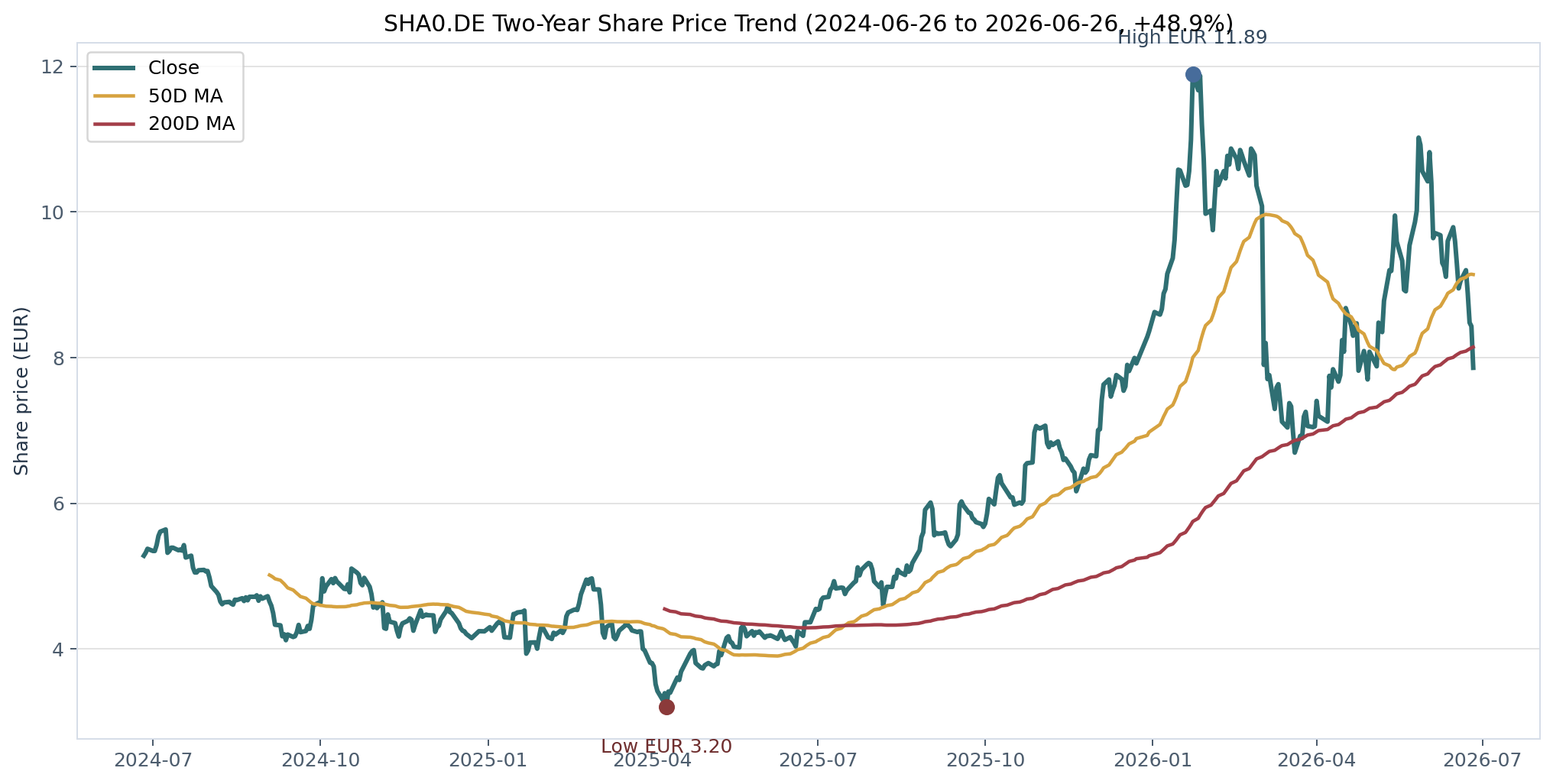
Source: Yahoo Finance chart API with yfinance fallback, daily close prices for SHA0.DE. Moving averages are calculated from daily closes.
1. Macro / Industry Context
Schaeffler's 2026 operating environment is not one of strong cyclical tailwinds: The S&P Global benchmark used by the company in its annual report assumes global GDP growth of nearly 3.0%, global vehicle production falling about 0.4% to 92.6 million units, along with global vehicle ownership growth of 2.0%-2.5% and industrial production growth of just over 2.5%. The implication of this set of assumptions for Schaeffler is that new car-related businesses should not be given high beta valuations, but aftermarket, industrial and aerospace bearings have a more stable demand chassis.
The structural contradiction lies in the power system: the decline in demand related to traditional drives suppressed Powertrain revenue, while the increased volume of electrified products pushed up E-Mobility revenue but still suffered losses. For stocks, the most important industry variable from 2026 to 2028 is whether customer platform ramping, price discipline, capacity utilization and integration synergy can converge E-Mobility's losses to a level that can be absorbed by other segments. Pure BEV penetration is not a core variable.
Industry judgment
Automotive OE:Low growth, driving structural migration, suitable for low multiple valuations.
After sales:The increase in vehicle ownership and vehicle age supports demand and is the highest quality cash flow in the portfolio.
Industrial/Bearings:Machinery, transportation equipment and electrical equipment are expected to grow 2.5%-3.0% in 2026, but regional differences will impact margins.
2. Company Overview and Segment Quality
Schaeffler is now a combination of automotive parts, after-sales and bearing industries. After the merger of Vitesco, the company is more focused on electrification and power systems, but the profit pool still comes from mature businesses. In 2025, the group's revenue will be EUR 23.492bn, adjusted EBIT EUR 936m, and adjusted EBIT rate 4.0%; of which E-Mobility revenue will grow but suffer losses, and P&C/VLS/B&IS will be the main axis of profit and cash flow.
| 2025A segment | Revenue (EUR bn) | Revenue mix | Adj. EBIT (EUR m) | Adj. EBIT margin |
|---|---|---|---|---|
| E-Mobility | 5.015 | 21.3% | -805 | -16.0% |
| Powertrain & Chassis | 8.900 | 37.9% | 933 | 10.5% |
| Vehicle Lifetime Solutions | 3.038 | 12.9% | 450 | 14.8% |
| Bearings & Industrial Solutions | 6.368 | 27.1% | 475 | 7.5% |
| Corporate / Other | 0.171 | 0.7% | -117 | -68.7% |
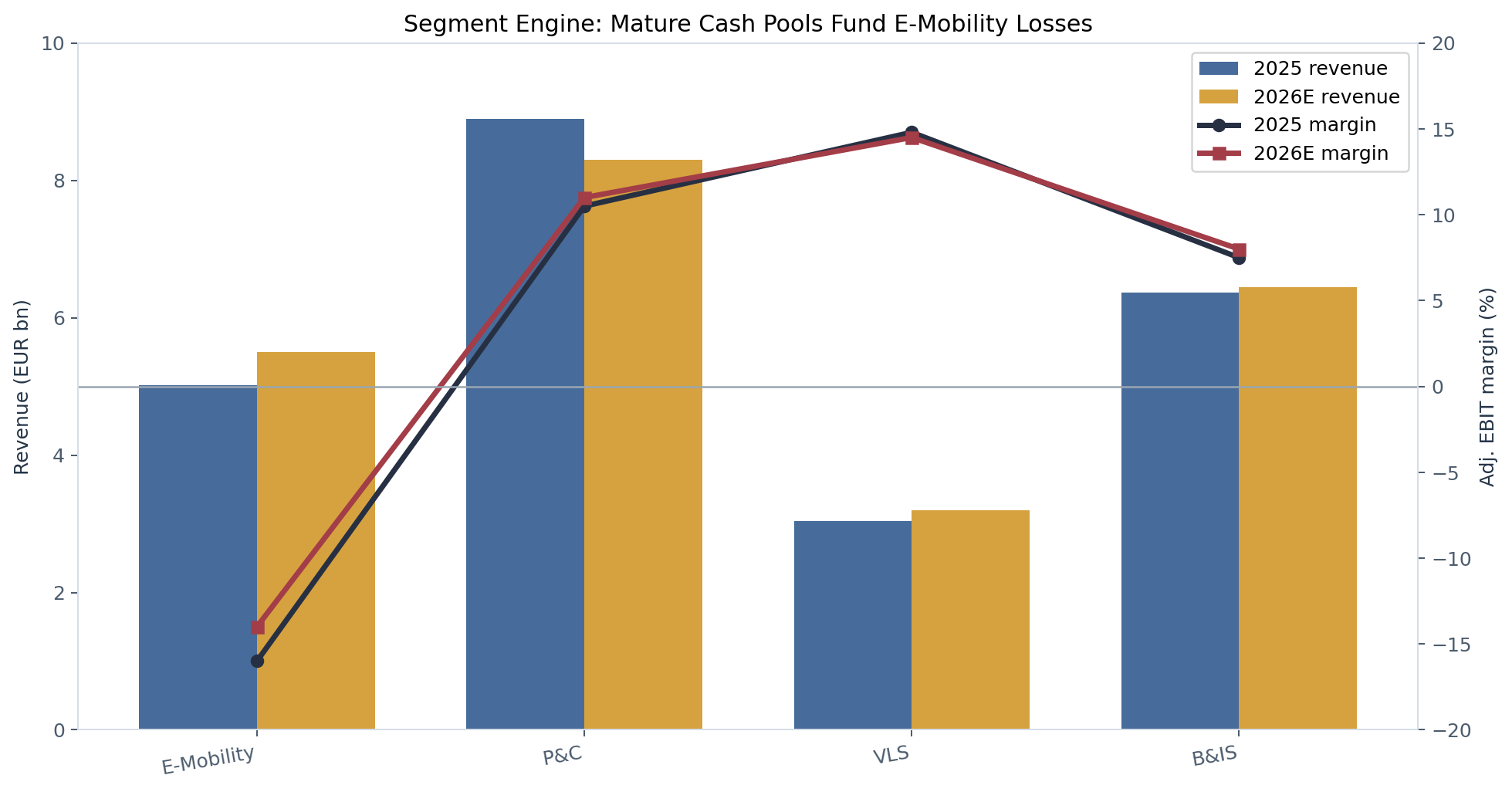
Source: Schaeffler FY2025 Annual Report; 2026E midpoint model by learnsomefinance.
Segment view
- E-Mobility:Strategy has the greatest optionality, but it is also the biggest drag on the income statement. We do not value it based on EBIT, but use 0.40x 2026E sales as the discount option value.
- Powertrain & Chassis:The legacy-driven downside cannot be ignored, but a 2026 guidance EBIT margin of 10%-12% suggests the cost structure remains resilient.
- Vehicle Lifetime Solutions:After-sales pricing, vehicle age and ownership are core moats and should enjoy the highest EBIT multiple within the portfolio.
- Bearings & Industrial Solutions:The industrial cycle is not strong, but profit margins improve in 2025, and aerospace bearings provide higher quality increments.
3. Competitor Landscape and Peer Comparison
Schaeffler's competition cannot be limited to one company: on the automotive OE side, it faces BorgWarner, Valeo, FORVIA, AUMOVIO, Bosch and ZF; on the after-sales side, it competes with Bosch, ZF Aftermarket, Valeo Service, SKF Automotive for the profit pool of repair and replacement parts; on the bearing/industrial side, it compares with SKF, Timken, NSK, NTN, JTEKT and other companies. This mixed attribute determines that the valuation should also be looked at separately, rather than simply applying a single auto parts multiple.
| Competition track | Main rivals | Schaeffler location | investment implications |
|---|---|---|---|
| Powertrain/Electrification OE | BorgWarner、Valeo、AUMOVIO、Bosch、ZF | P&C already has double-digit profit margins, but E-Mobility is still losing money; after the integration of Vitesco, the product coverage is more complete, but the complexity has increased. | Compared with BorgWarner, Schaeffler's mature powertrain profitability is not bad, and the valuation discount mainly comes from E-Mobility losses and integration execution. |
| After Sales / Vehicle Lifetime Solutions | Bosch、ZF Aftermarket、Valeo Service、SKF Automotive | With a 2025 adjusted EBIT margin of 14.8%, VLS is the business with the highest cash flow quality in the portfolio. | The after-sales business provides a defensive profit pool and should theoretically enjoy a valuation multiple higher than the group average. |
| Bearings / Industrial Movement | SKF、Timken、NSK、NTN、JTEKT | B&IS 2025 adjusted EBIT margin of 7.5% is below the high teens cash margins of SKF Industrial and Timken, but aerospace and industrial distribution offer room for repair. | If B&IS's profit margin converges with its peers, 7.5x EBIT in SOTP is still conservative; if industrial demand does not recover, the room for upward valuation revision will be limited. |
| Capital Structure/Transformation Execution | FORVIA、Valeo、AUMOVIO、SKF | Schaeffler's 1Q26 net debt/adjusted EBITDA was 2.2x, with a lower shareholder equity ratio than typical industrial peers. | While peers have already laid out the path to deleveraging and portfolio slimming, Schaeffler needs to use FCF to prove that consolidation will not eat away at profit repair. |
Financial comparison of listed peers
The table below uses the 2025 results disclosed by each company. Since companies have different calibers, profit margins include adjusted EBIT, operating margin or adjusted EBITDA, which are suitable for directional comparisons and should not be mechanically regarded as valuation inputs of exactly the same caliber.
| Company | FY2025 revenue | Profitability | Cash flow / leverage reference | Competitive position | Read-through for Schaeffler |
|---|---|---|---|---|---|
| Schaeffler | EUR 23.5bn | 4.0% adj. EBIT | FCF before M&A EUR 266m; net debt / adj. EBITDA 2.1x at FY25 | Automotive OE, electrification, aftermarket and industrial bearing hybrid. | The profit margin is lower than that of mature bearing/power system peers, but the asset portfolio is more diversified; the core of the stock price is the convergence of loss-making businesses and deleveraging. |
| Valeo | EUR 20.9bn | 4.7% operating; 14.7% EBITDA | FCF EUR 589m; net debt / adj. EBITDA 1.3x | Electrical, ADAS, lighting, power systems, automotive OE exposure is higher. | Like Schaeffler, it belongs to the same European transformation repair stock; Valeo's cash flow and leverage are cleaner, which is the financial target that Schaeffler needs to catch up with. |
| FORVIA | EUR 26.2bn | 5.6% operating | Net cash flow EUR 962m; net debt / adj. EBITDA 1.7x | Seats, interiors, electronics, and lighting are promoting combination slimming and deleveraging. | Larger scale, slightly higher margins; FORVIA's portfolio reshaping shows that European parts stocks can rely on asset disposals and cash flow to improve their valuation narrative. |
| BorgWarner | USD 14.3bn | 10.7% adjusted operating | FCF USD 1.208bn | Power systems, thermal management, eProducts, hybrid and electric products are growing rapidly. | The closest high-quality benchmark is Schaeffler P&C/E-Mobility; Schaeffler P&C margins are close, but the group is diluted by E-Mobility losses. |
| SKF | SEK 91.6bn | 12.7% adj. operating; Industrial 16.1%, Automotive 4.1% | Operating cash flow after investments SEK 6.892bn; net debt / adj. EBITDA 0.8x | The global bearing leader is preparing to spin off its Automotive business. | Note that bearing/industrial assets should have higher margins and lower leverage; Schaeffler B&IS still needs to prove it can move closer to its industrial peers. |
| Timken | USD 4.6bn | 17.4% adjusted EBITDA | FCF USD 406m; net debt / adj. EBITDA 2.0x | Engineered bearings and industrial motion, smaller in scale but high in profit quality. | As a higher purity bearing/industrial motion peer, Timken underpins Schaeffler B&IS enjoying higher segment multiples than automotive OE. |
Competitive Landscape Judgment
Schaeffler's mature business is not a weak asset: P&C's 2025 adjusted EBIT margin of 10.5% is close to BorgWarner's adjusted operating margin, and VLS's 14.8% margin also has after-sales asset attributes. The problem is that these profit pools are obscured by E-Mobility's losses, higher financing costs and consolidated cash flow.
What it means for valuation
Peer comparisons support SOTP: VLS and B&IS should be given multiples higher than car OE, P&C should be given mature but discounted powertrain multiples, and E-Mobility can only be valued at discounted sales option. If E-Mobility's loss rate cannot continue to improve in 2026-2027, it will be difficult for Schaeffler to move closer to industrial quality assets such as SKF/Timken.
4. Financial Statement Analysis
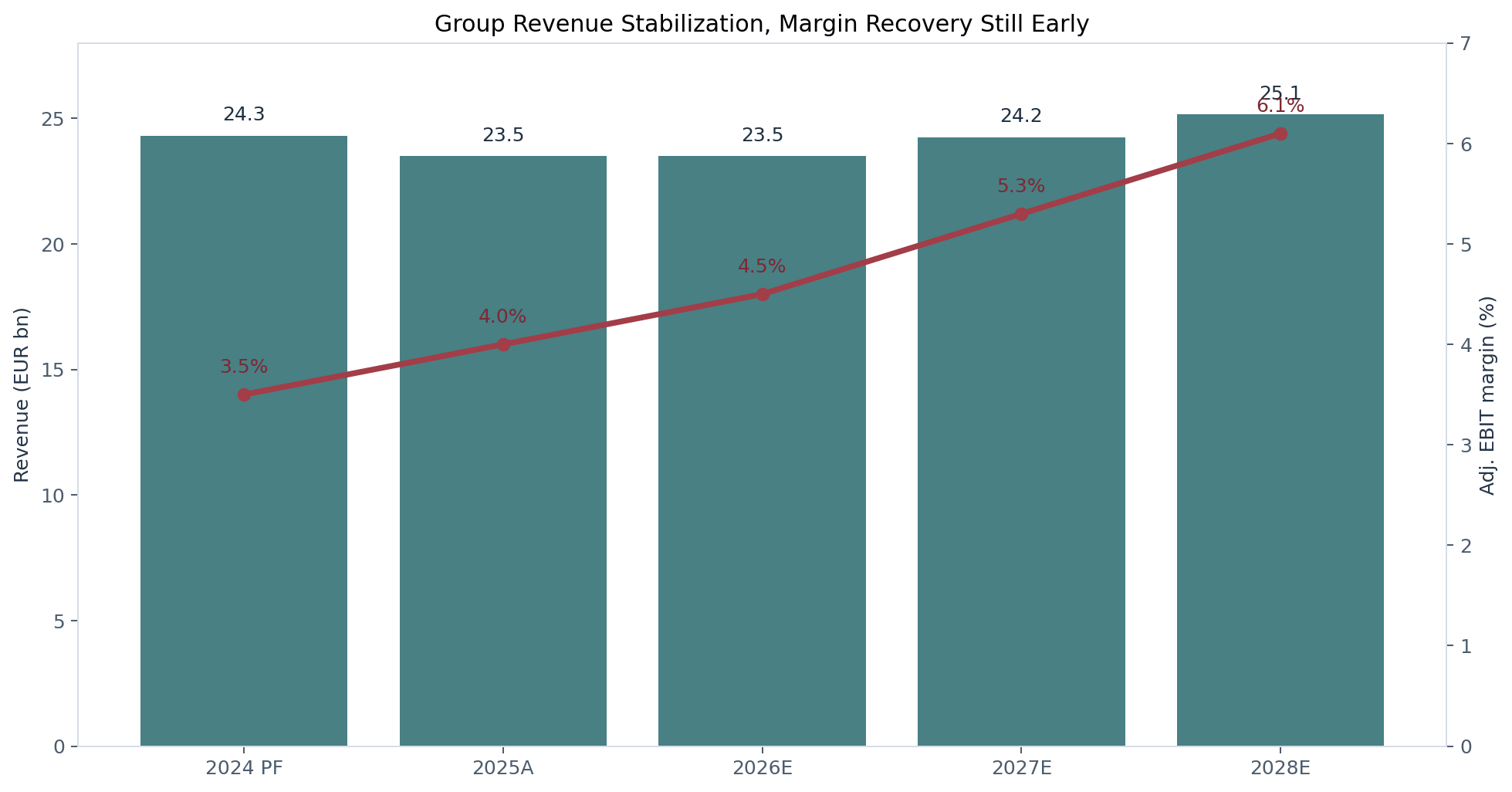
Source: Schaeffler FY2025 Annual Report, Q1 2026 Interim Statement, company FY2026 guidance, learnsomefinance estimates.
Income Statement
| EUR m unless stated | FY2025A | 1Q2026A | FY2026E |
|---|---|---|---|
| Revenue | 23,492 | 5,764 | 23,500E |
| Gross profit / margin | 4,321 / 18.4% | 1,234 / 21.4% | 5,020E / 21.4%E |
| R&D expense | -1,582 | -393 | -1,560E |
| Selling + admin | -2,466 | -595 | -2,470E |
| EBIT | 295 | 270 | c.700E |
| EBIT before special items | 936 | 285 | 1,058E |
| Financial result | -315 | -105 | c.-420E |
| Net income attributable | -424 | 60 | c.130E reported / c.410E normalized |
The 2025 gross profit margin of 18.4% seems low, but it has returned to 21.4% in 1Q26, which is basically the same as 1Q25. The key on the expense side is whether R&D and SG&A can be absorbed by revenue when the electrification platform ramps up; we expect FY2026 reported EBIT to still be affected by restructuring and integration expenses, and normalized EPS is a better reflection of profitability than reported EPS.
Balance Sheet and Liquidity
| Metric | FY2025A | 1Q2026A | Read-through |
|---|---|---|---|
| Total assets | 21,028 | 21,355 | Stable asset base after Vitesco integration |
| Shareholders' equity | 3,054 | 3,140 | Equity ratio 14.7% at 1Q26 |
| Financial debt | 7,286 | 7,309 | Bond-heavy profile; 2026/2027 maturities visible |
| Cash and equivalents | 2,371 | 2,166 | Liquidity supported by undrawn EUR 3.0bn RCF at FY25 |
| Net financial debt | 4,915 | 5,143 | Seasonal 1Q increase |
| Net debt / EBITDA before special items | 2.1x | 2.2x | Key constraint for rerating |
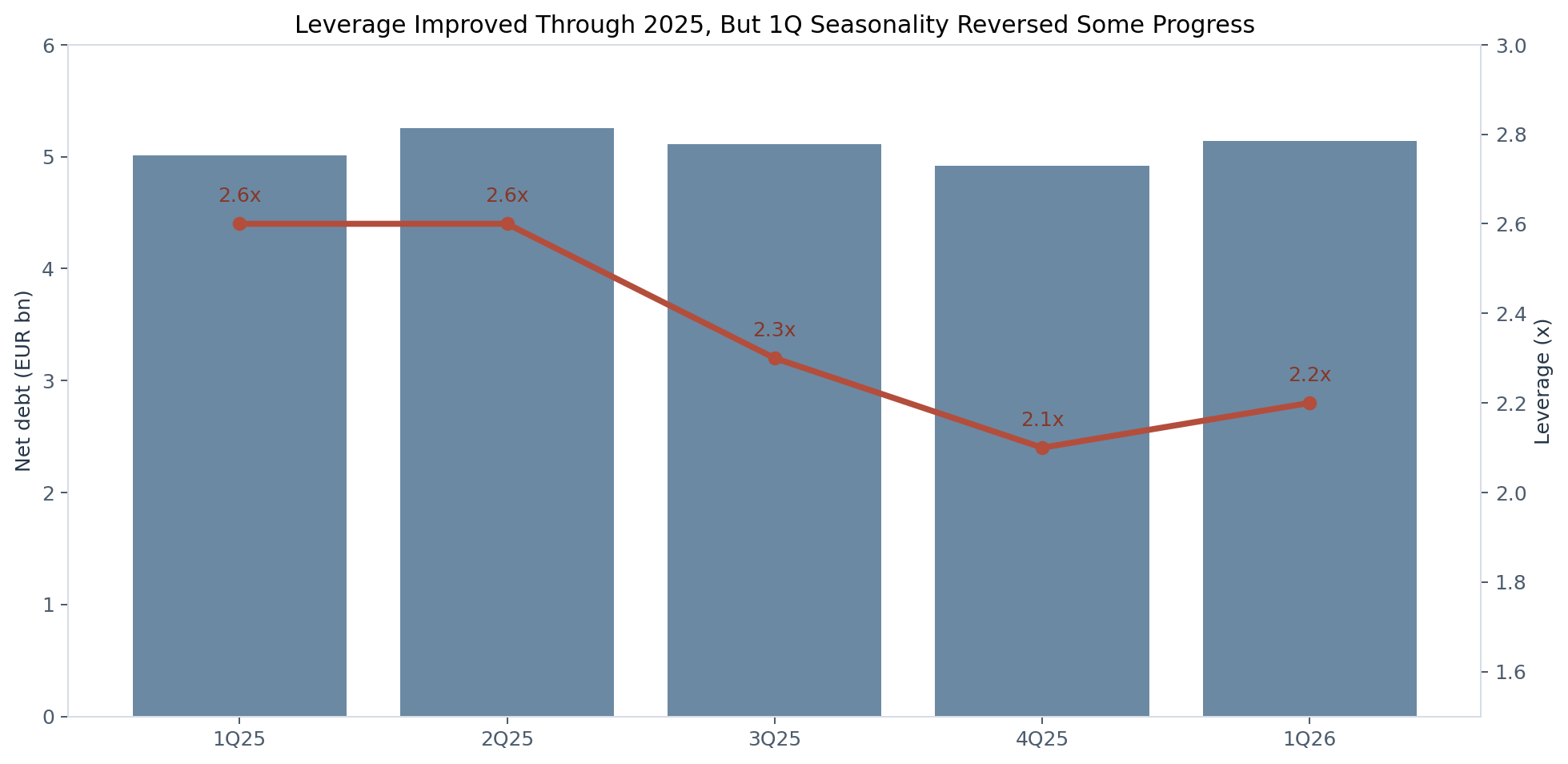
Source: Schaeffler Q1 2026 Interim Statement. Leverage is net financial debt / EBITDA before special items, LTM.
Cash Flow and Earnings Quality
| EUR m unless stated | FY2025A | 1Q2026A | Interpretation |
|---|---|---|---|
| Cash flow from operations | 1,355 | 60 | Working-capital seasonality in 1Q |
| Capex | 974 | 237 | 4.1% of revenue in FY25 and 1Q26 |
| FCF before M&A | 266 | -209 | Company FY26 guide EUR 100-300m |
| FCF before M&A and before special items | 503 | -50 | Better read-through to normalized earning power |
| FCF conversion vs adj EBIT | 0.3x | 0.2x LTM | Below long-cycle industrial quality target |
The quality of FCF before M&A is the most important verification item in this case. The company achieved EUR 266m FCF before M&A in FY2025 despite significant special items and consolidation expenses; 1Q26 was EUR -209m, which management explained as seasonal factors. We regard 2026 as the FCF trough year. If H2 cannot clearly return to positive, the Buy logic needs to be downgraded.
5. Forecast Model and Operating Bridge
Our baseline model uses the company's 2026 guidance midpoint and bases the 2027-2028 recovery on three assumptions: E-Mobility loss rates converge on a year-over-year basis, VLS maintains mid-to-high teens margins, and B&IS moves toward 8%+ margins driven by industrial/aerospace demand. A strong recovery in automobile production is not considered a necessary condition.
| Period | Revenue (EUR bn) | Growth | Adj. EBIT (EUR bn) | Adj. EBIT margin | FCF before M&A (EUR bn) |
|---|---|---|---|---|---|
| 2024 PF | 24.3 | - | 0.842 | 3.5% | - |
| 2025A | 23.5 | -3.4% | 0.936 | 4.0% | 0.266 |
| 2026E | 23.5 | 0.0% | 1.058 | 4.5% | 0.200 |
| 2027E | 24.2 | 3.2% | 1.285 | 5.3% | 0.550 |
| 2028E | 25.1 | 3.7% | 1.534 | 6.1% | 0.750 |
| 2026E segment | Revenue (EUR bn) | Adj. EBIT margin | Adj. EBIT (EUR m) |
|---|---|---|---|
| E-Mobility | 5.50 | -14.0% | -770 |
| Powertrain & Chassis | 8.30 | 11.0% | 913 |
| Vehicle Lifetime Solutions | 3.20 | 14.5% | 464 |
| Bearings & Industrial Solutions | 6.45 | 8.0% | 516 |
| Corporate / Other | 0.05 | n.m. | -65 |
2027-2028 Derivation
Income:The flatness in 2026E is mainly due to the decline in P&C being offset by E-Mobility/VLS/B&IS; the recovery to 3%-4% growth in 2027E-2028E comes from the electrification ramp, solid after-sales growth and moderate industrial recovery.
Profit rate:Group adjusted EBIT margin improved to 6.1% in 2028E from 4.0% in 2025, mainly contributed by E-Mobility loss margin improvement, restructuring savings and B&IS mix improvement.
Cash flow:2026E FCF before M&A adopts the midpoint of the company's guidance of EUR 200m; 2027E/2028E are raised to EUR 550m/EUR 750m respectively, but the discounts on restructuring cash flow and interest expenses are still retained.
6. Valuation
We use SOTP as the main valuation method and use EV/EBITDA sanity check. SOTP is a better fit for Schaeffler because the quality of growth versus margins in E-Mobility, aftermarket, industrial bearings and traditional powertrains are completely different. The target EV is EUR 14.41bn. After deducting the 1Q26 net financial debt of EUR 5.143bn, the equity value is EUR 9.27bn, corresponding to EUR 9.81 per share, rounded to EUR 9.80。
| Business | Valuation base | Base amount (EUR bn) | Multiple / method | EV contribution (EUR bn) |
|---|---|---|---|---|
| E-Mobility | 2026E revenue | 5.5 | 0.40x sales | 2.20 |
| Powertrain & Chassis | 2026E adj. EBIT | 0.91 | 5.8x EBIT | 5.30 |
| Vehicle Lifetime Solutions | 2026E adj. EBIT | 0.46 | 8.5x EBIT | 3.94 |
| Bearings & Industrial Solutions | 2026E adj. EBIT | 0.52 | 7.5x EBIT | 3.87 |
| Corporate / Other | 2026E adj. EBIT | -0.07 | Capitalized overhead | -0.90 |
| Implied enterprise value | 14.41 | |||
| Less: 1Q26 net financial debt | -5.14 | |||
| Equity value / share | EUR 9.81 |
Multiple Check
The current EV is about EUR 12.6bn, and the adjusted EBITDA for 2026E is about 5.0x;The target EV corresponds to approximately 5.7x. This multiple does not assume that the company returns to a high-quality industrial leader valuation, but only gives a mid-cycle discount valuation in which "integration risks are reduced and profit margin repair is visible."
Key Valuation Debate
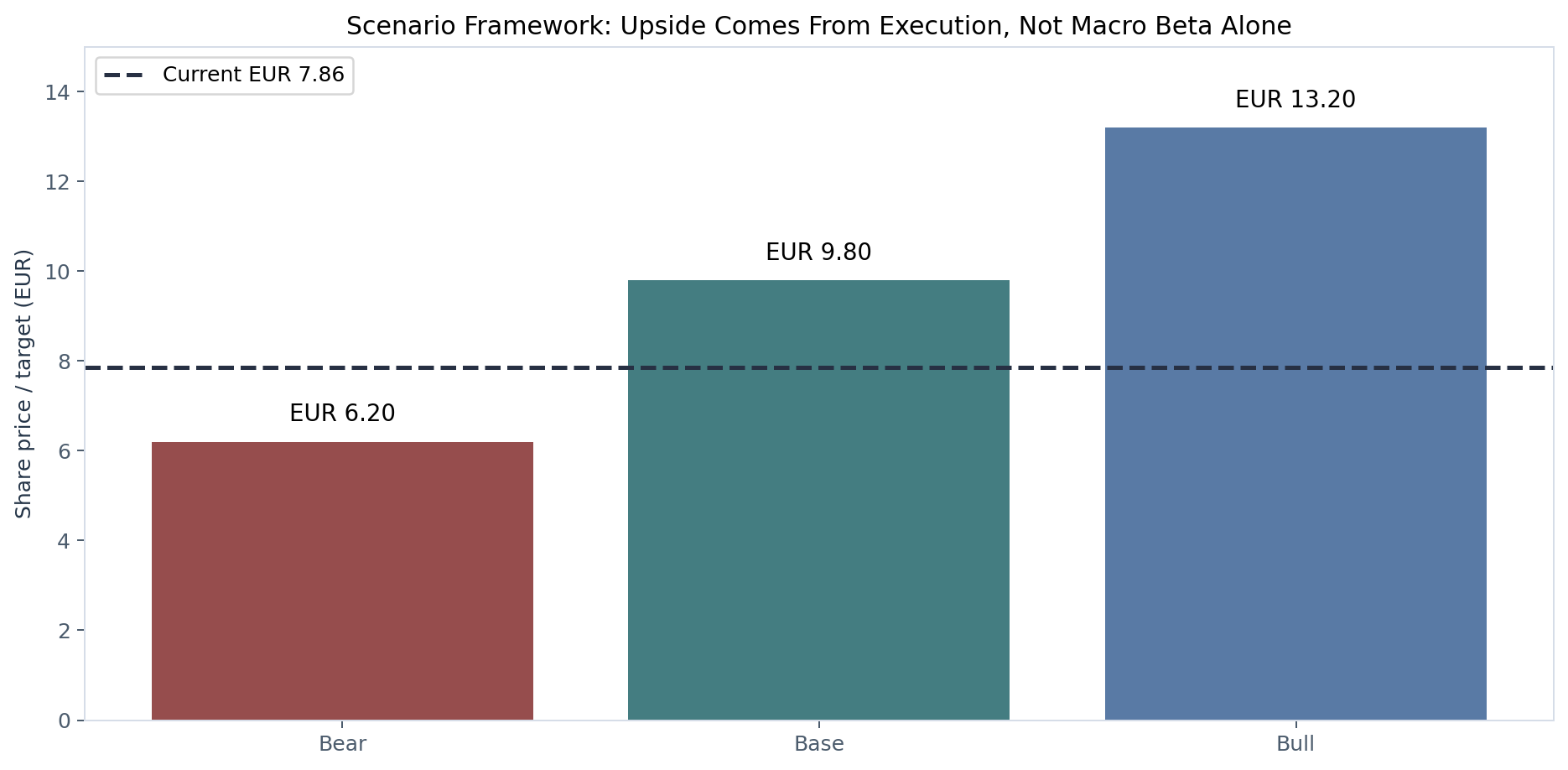
If investors believe E-Mobility is permanently loss-making and P&C's ICE downside erodes all synergies, the stock is closer to a bear case of EUR 6; if E-Mobility losses narrow significantly by 2028, after-sales and bearings cash flow quality will be repriced.
| Scenario | Probability | Target price | Core assumptions |
|---|---|---|---|
| Bear | 25% | EUR 6.20 | Guidance low end, E-Mobility loss near -15%, net debt stays above EUR 5.3bn. |
| Base | 50% | EUR 9.80 | FY26 midpoint, 2027 margin bridge visible, FCF trough treated as integration year. |
| Bull | 25% | EUR 13.20 | E-Mobility losses halve by 2028, VLS/Bearings compound, group margin exits above 6%. |
7. Catalysts and Monitoring Checklist
Positive Catalysts
- 2026-08-05 H1 results show FCF seasonal reversal, net debt fell back.
- E-Mobility's adjusted EBIT loss margin moved closer to the upper half of the company's 2026 guidance.
- VLS maintains an EBIT margin above 14% and continues to benefit from vehicle age and ownership growth.
- Vitesco consolidates synergies and restructures cash flow below market fears.
Negative Catalysts
- Automotive production/customer platform pace was weaker than company benchmarks, and P&C revenue fell more than expected.
- FCF did not improve in 1H26, causing net debt/adjusted EBITDA to return to around 2.5x.
- Rating pressure has pushed up financing costs and compressed normalized EPS.
- E-Mobility price, warranty or capacity utilization is not up to standard.
8. Risks
Leverage and refinancing:FY2025 financial debt EUR 7.286bn, 1Q26 net financial debt EUR 5.143bn. The company's debt maturity has been lengthened, but its rating is in the BB+/Ba1 range, and interest expenses are highly elastic to net profit.
Execution risk:Vitesco consolidation, restructured cash flow, platform ramp-up and quality costs could all impact 2026-2027 FCF. Schaeffler's equity ratio is only about 14.5%-14.7%, giving it less margin for error than a typical high-quality industrial company.
End-market risk:Global automobile production is expected to decline slightly, and the traditional driving structure continues to decline; if demand in China and Europe is lower than expected, it will affect both P&C and B&IS.
Questions for Management
- What is the tempo of restructuring and consolidated cash flow spend in 2026 in H1/H2? Is the maximum swing factor at the midpoint of FY2026 FCF guidance working capital, capex or special items?
- Does the improvement in loss ratio of E-Mobility new project ramp come from pricing, capacity utilization, material cost or product mix? Can a break-even path be given in 2027?
- How long will P&C’s portfolio streamlining last? Will conventional powertrain decline be adequately offset by chassis and control systems?
- Is the VLS price adjustment sustainable, or is it a one-time inflation pass-through in 2025-2026?