Notes of the white-haired stock goddess: The core logic of POET AGM
Original tweet:https://x.com/aleabitoreddit/status/2071488272245944399
Original material:This page combines this X/Twitter tweet, user-provided POET AGM notes, AGM screenshots, and public information into investment analysis. The key sentence in the AGM screenshot is: The existing production capacity is approximately 1 million optical engines/year, and demand by the end of 2027 may reach 1 million engines/month, so it takes about 10 times expansion of production。
| Topic | AGM/note content | Analyze meaning |
|---|---|---|
| laser bottleneck | AGM slide quotes LightCounting: The three major laser suppliers control about 68% of the market, are basically sold out within the next two years, and are not expanding production fast enough. | If the tight supply Lumentum says holds true into 2028, POET's external light source/light engine route will be repriced by the market as a "key bottleneck alternative." |
| NRE new customers | AGM reveals signing of $1.0M+ NRE with new client to build high-power external light source with POET interposer. | Combined with the 2025-09-29 POET + Sivers cooperation announcement on ELS/DFB lasers, Sivers may become an important candidate for the mass production laser supply chain, but AGM did not directly name it. |
| Lumilens | POET said the initial purchase order for Lumilens is $50M+, with the commercial agreement expandable to $500M+ over the next five years. | If the initial end customer of Lumilens is indeed a top-3 hyperscaler, this will significantly improve the quality of orders; the identity of this hyperscaler comes from OSINT and has not been officially confirmed by POET. |
| Cash and Execution | AGM management said it has approximately $830M in cash on the balance sheet; it also has existing production capacity of approximately 1 million optical engines/year. | After the short-term financial pressure decreased, the core issues turned to production expansion, certification, yield, delivery and customer verifiability. |
| Capacity jump | Screenshots of AGM Q&A show that management discussed that demand may reach about 1 million engines/month by the end of 2027, implying about a 10-fold capacity expansion. | This is a very strong directional signal and should be regarded as an execution milestone in investment, and the realization of income still needs to be verified later. |
Why is this logic so tempting?
Opportunities for POET arise from real bottlenecks in the AI optical interconnect supply chain. Small companies with mass-produced optical interposer/ELS platforms may move from fringe suppliers to capacity alternatives. AGM's 10x production capacity discussion is the most important operating lever in the entire story.
Where discounts are needed
POET's customer transparency remains weak compared to suppliers like AAOI, which has disclosed orders from large customers. End customers of Lumilens, ELS and unnamed customers need stronger verification; otherwise, the 500M+ agreement and 1M engines/month demand can only be regarded as forward option value.
Company Profile: What does POET do?
POET Technologies is a photonic integration and optical engine company whose core technology is POET Optical Interposer. It seeks to integrate lasers, modulators, detectors, waveguides and electronic packaging into AI data center optical interconnects in a lower-cost, higher-density manner.
| question | brief answer |
|---|---|
| Company positioning | POET Technologies is a photonic integrated circuits / optical engines company whose core platform is POET Optical Interposer. |
| what does it sell | Mainly for AI data centers and high-speed interconnection, it provides optical engines, external light source, receiver/transmitter engines, and co-packaged optics related modules. |
| Why is it important | The bandwidth, power consumption, and packaging density requirements of AI clusters are rising rapidly, and optical interconnects have transformed from “network components” to bottlenecks in training and inference infrastructure. |
| business stage | The company is still in the transition stage from design win / NRE / PO to H2 2026 production ramp, with a low revenue base but aggressive backlog and capacity targets. |
China Competition and Substitution Analysis
Conclusion:China currently has a strong supply chain for optical modules, optical devices and laser chips, but it has yet to see a listed company completely replicate POET’s Optical Interposer + ELS + optical engine platform positioning. China's substitution pressure mainly comes from segmented capability portfolio.
| level of judgment | answer | Reason |
|---|---|---|
| Whole company level | There is currently no complete replacement for the same type in China | POET’s unique points are in the optical interposer, ELS, light engine integration and AI data center customer validation paths. Chinese listed companies are more concentrated in single links of optical modules, optical devices, laser chips or packaging manufacturing. |
| supply chain level | China has strong segmented alternatives | Zhongji InnoLight and Xinyi Sheng cover high-speed optical modules, Tianfu Communications covers optical device platforms, Yuanjie Technology covers laser chips, and Optics Technology and Cambridge Technology cover optical module/optical device manufacturing. |
| investment implications | Domestic substitution pressure comes from combination boxing | If POET cannot make the interposer platform a customer certification and mass production advantage, single-link domestic suppliers will compete in terms of cost, response speed and customer distance. |
| Chinese company | Main alternative links | Location in public profile | Comparison with POET |
|---|---|---|---|
| Zhongji InnoLight | High-speed optical module, 800G/1.6T data center interconnection | As the domestic leader in high-speed optical modules, public data shows that demand for AI data centers is the main line of growth. | Closest to POET downstream module customers/ecological position; partial to finished modules, the technical path is different from the POET interposer platform. |
| Xinyisheng | High-speed optical modules, data center optical interconnection | Public annual reports and announcements show that the company benefits from demand for high-speed optical modules. | Comparable to POET's customer demand side and modular delivery, the business focuses on finished optical modules, and ELS/interposer pure play attributes are weak. |
| Tianfu Communications | Optical components, passive components, optical engine related parts | The company has long-term coverage of optical communication precision components and is an important upstream of China's optical module supply chain. | Closer to the device/package layer where POET resides, the product mix still diverges from the POET platform architecture. |
| Yuanjie Technology | Laser chip, DFB/EML related capabilities | With optical chips as its core, the company can map the upstream links of laser bottleneck in AGM. | It can be used as an alternative observation target for domestic lasers; POET focuses on interposer/engine integration. |
| Guangxun Technology | Optical devices, optical modules, subsystems | Optical communication devices have a wide coverage and have relatively complete industrial chain capabilities. | In China's supply chain, it is more like a wide-aperture optical device platform, forming a multi-link reference for POET. |
| Cambridge Technology | Optical modules, data communications and telecommunications network equipment | Highly relevant to the needs of high-speed optical modules and AI data centers. | It is more suitable as a reference for finished module/system manufacturing and cannot directly copy POET’s interposer technology positioning. |
Sources: Chinese listed-company annual reports and public filings for Innolight, Eoptolink, TFC, YJ Semitech, Accelink and Cambridge Technology. The comparison is by learnsomefinance.
Executive Summary: Investment Conclusion
Investment conclusion:Give POET Observation / High Risk. The most noteworthy increase after AGM is the demand discussion that the company will push its production capacity target from about 1 million optical engines/year to about 1 million optical engines/month by the end of 2027 while obtaining a stronger cash buffer after financing. If this path is realized, POET will move from a technology platform story to an AI optical interconnect bottleneck production capacity story.
Market divergence:Bulls focus on laser shortages, Lumilens, ELS NRE and 10x production expansion; skeptics focus on insufficient customer naming, still early revenue recognition, unknown mass production yields and post-financing dilution. The reasonable approach at this stage is to put POET into the AI optical bottleneck observation pool and wait for evidence of customers and revenue from H2 2026 to 2027.
| Dimensions | current judgment | Analyze meaning |
|---|---|---|
| Investment conclusion | Watch / High Risk | POET is suitable to be placed in the AI optical interconnection bottleneck observation pool. The directional logic is very strong, but customer and mass production verification is still insufficient. |
| core mispricing | The market may be underestimating the bottleneck value of optical interposer/ELS platforms | If the tight supply of lasers continues, POET's external light source and light engine routes may be repriced as supplementary production capacity. |
| biggest disagreement | Order quality and customer transparency | Lumilens, NRE and 1M engines/month demand requires verification from customer side, supplier side or revenue confirmation. |
| bottom line | Cash improvement does not equal commercialization success | Post-money cash enhances fault tolerance and share price re-rating remains dependent on H2 2026-2027 ramp, yields and certifications. |
Key Takeaways: Core Takeaways
Recent Two-Year Share Price Trend: Stock price trend in the past two years
POET's stock price in the past two years has clearly reflected the narrative of AI optical interconnection and improved runway after financing. The implication of this analysis is that the market has paid part of the option value, and subsequent upward movement requires continued follow-up of actual revenue, customer certification and production expansion data.
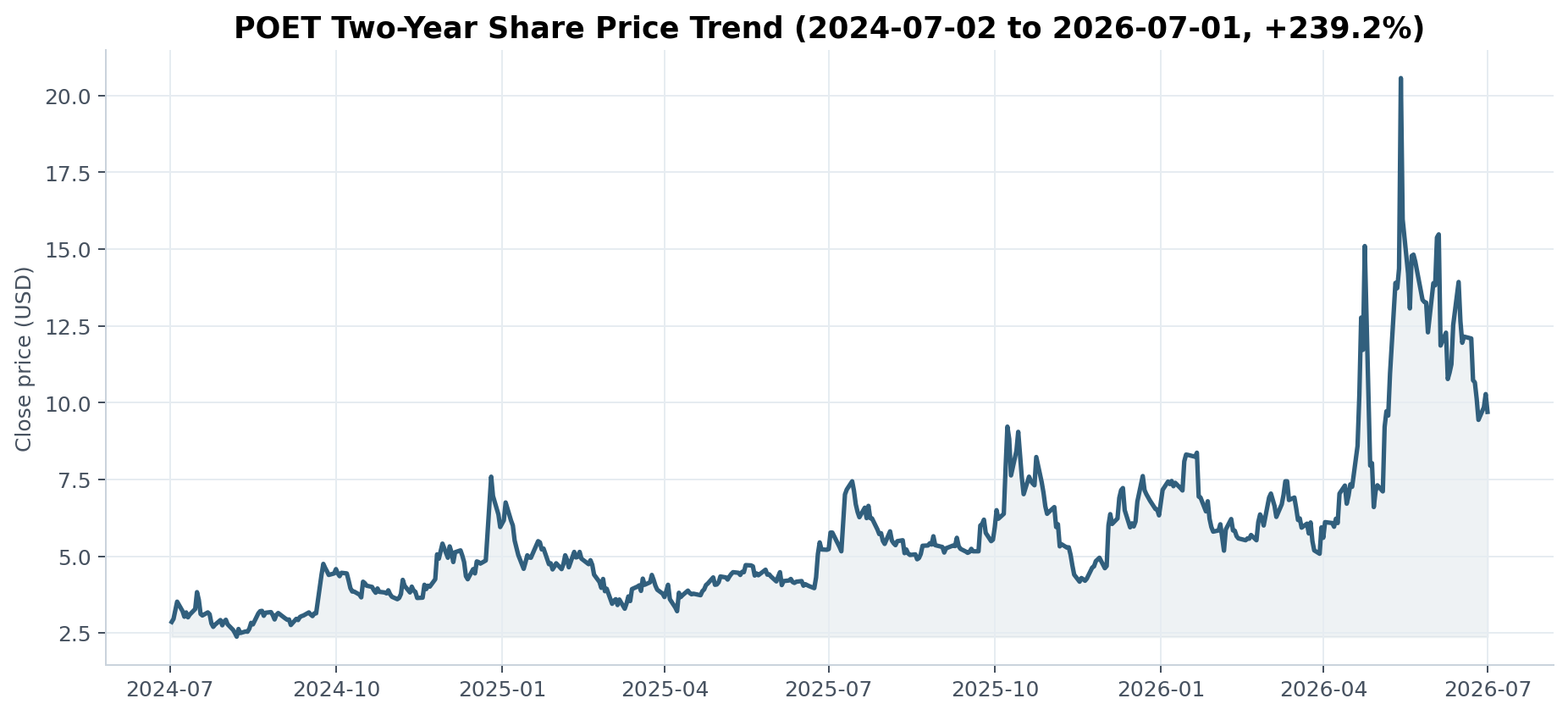
Source: Yahoo Finance chart API with local CSV fallback, POET daily closing price. Chart generated by learnsomefinance.
Market Context: Is the optical shortage real enough?
AI clusters are upgrading optical interconnects from traditional data center networks to computing infrastructure. The common problem for 800G/1.6T transceivers, external light sources, silicon photonics/photonic packaging and co-packaged optics is that bandwidth requirements rise rapidly, but laser, packaging, thermal management and reliability certification do not scale linearly.
| Dimensions | Involved links | Meaning of POET |
|---|---|---|
| shortage position | Lasers, external light sources, optical engines, 800G/1.6T interconnects | AGM directly stated that the optical components industry is facing a serious shortage of key components; the bottleneck spreads from DSP/modules to laser supply. |
| demand driven | AI hyperscaler cluster, GPU network, co-packaged optics | The Optica 2026 roadmap points out that photonics-enabled AI requires higher bandwidth and energy efficiency, and optical interconnect has become a key technology route for computing expansion. |
| Supply landscape | Lumentum, Coherent and other head laser/optical suppliers | Leading suppliers have strong order visibility and tight production capacity. The opportunity for POET is to bypass or alleviate single point supply bottlenecks through interposers and ELS structures. |
| Verification threshold | Reliability, thermal management, customer certification, mass production yield | After optical components are ordered, they still need to pass customer certification, reliability testing and batch yield verification. The path from PO/NRE to revenue depends on these nodes. |
The key judgment in AGM is: If the three major laser suppliers have controlled 68% of the share and sold out in the next two years, the value of POET will extend from optical engine products to bottleneck relief solutions for hyperscalers and module manufacturers.
Company Overview and Segment Quality:Company and business quality
POET is still in the early stages of commercialization and using the segment margin framework of an established company would be distorted. A more appropriate way to dismantle it is to look at the four lines of platform, product, customer project and cash runway.
| Business/Platform | content | quality judgment |
|---|---|---|
| Optical Interposer | POET's underlying platform integrates photonic devices and electronic packaging into low-cost, high-density architectures. | The technical barrier is the highest and is also the core of valuation; it requires mass production yield and customer certification. |
| Optical Engines | For the core commercial products of AI data center interconnection, AGM discusses the current 1M/year production capacity and the 2027 exit 1M/month demand. | Operating leverage is the largest; capacity expansion and delivery pace determine the revenue curve. |
| External Light Source | Relevant to laser supply chains such as Sivers, the goal is to alleviate the bottleneck of high-power external light sources. | It is most tightly bound to the laser shortage logic; the identities of customers and suppliers need to continue to be confirmed. |
| NRE / Custom Programs | POET is an important transitional form of current commercialization and helps customers verify the platform. | It can provide technical verification and cash flow clues, but repeat orders and volume production revenue are the key. |
Orders, NREs, and Customer Credibility
The most important thing for POET right now is whether the disclosed orders, NREs and customer certifications can enter volume production. The biggest disagreement here is that the order title is large, and the customer naming and final terminal application are still not transparent enough.
| Client/Project | Disclosure amount | Product direction | credibility judgment |
|---|---|---|---|
| Lumilens | US$50M+ initial PO; US$500M+ business agreement potential over the next five years | POET Optical Interposer-based engines | The largest commercial clue has been disclosed; the identity of the terminal hyperscaler still needs to be confirmed by the official or customer side. |
| New ELS Customers | $1.0M+ NRE | High-power external light source | Logically linked to Sivers ELS partnership announcement, but supplier identity is inferred. |
| Systems integrator | 5M+ USD PO | Custom optical engines / modules | Prove that POET doesn't just serve a single customer, but needs to track repeat orders. |
| Adtran | 0.5M+ USD PO | Optical network related engines | Traditional communications customers help validate the process, but not at the same scale as hyperscalers. |
About Sivers' inferred bounds
2025-09-29 POET and Sivers announcement clearly uses POET interposer and Sivers DFB lasers for advanced AI photonic solutions / ELS. However, AGM’s new NRE customer did not directly name Sivers, so “mass production will benefit Sivers” is an inference based on supply chain clues and has not been officially confirmed by POET.
Capacity and revenue sensitivity
The capacity bridge given by the AGM screenshot is very aggressive: existing capacity is about 1 million engines/year, while demand at the end of 2027 may be about 1 million engines/month. If it comes true, POET will have to move from early mass production to high-throughput manufacturing, and the core variables will become yield, supply chain, packaging production line and customer acceptance.
| node | numbers | Source / caliber | Analyze meaning |
|---|---|---|---|
| Existing capacity | Approximately 1 million optical engines/year | AGM Q&A management caliber | Corresponds to early mass production preparations. |
| End of 2027 demand | Approximately 1 million optical engines/month | AGM Q&A screenshot caliber | The annual production is about 12 million units, which is about 12 times the demand of the current production capacity. |
| Expansion requirements | About 10x level expansion | Management said it will need to expand production in the next 6-9 months | This amplifies execution risk and, if successful, operating leverage. |
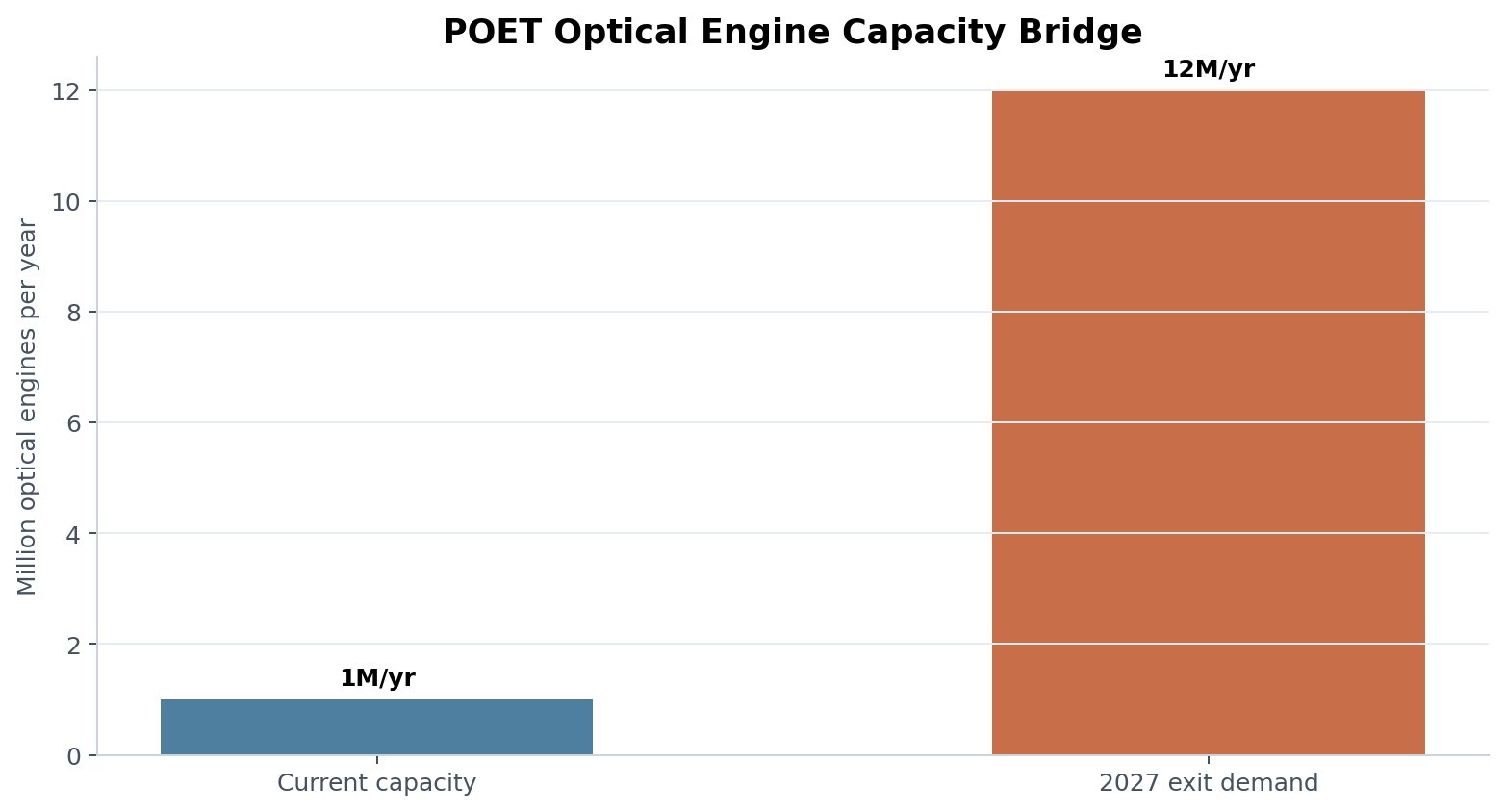
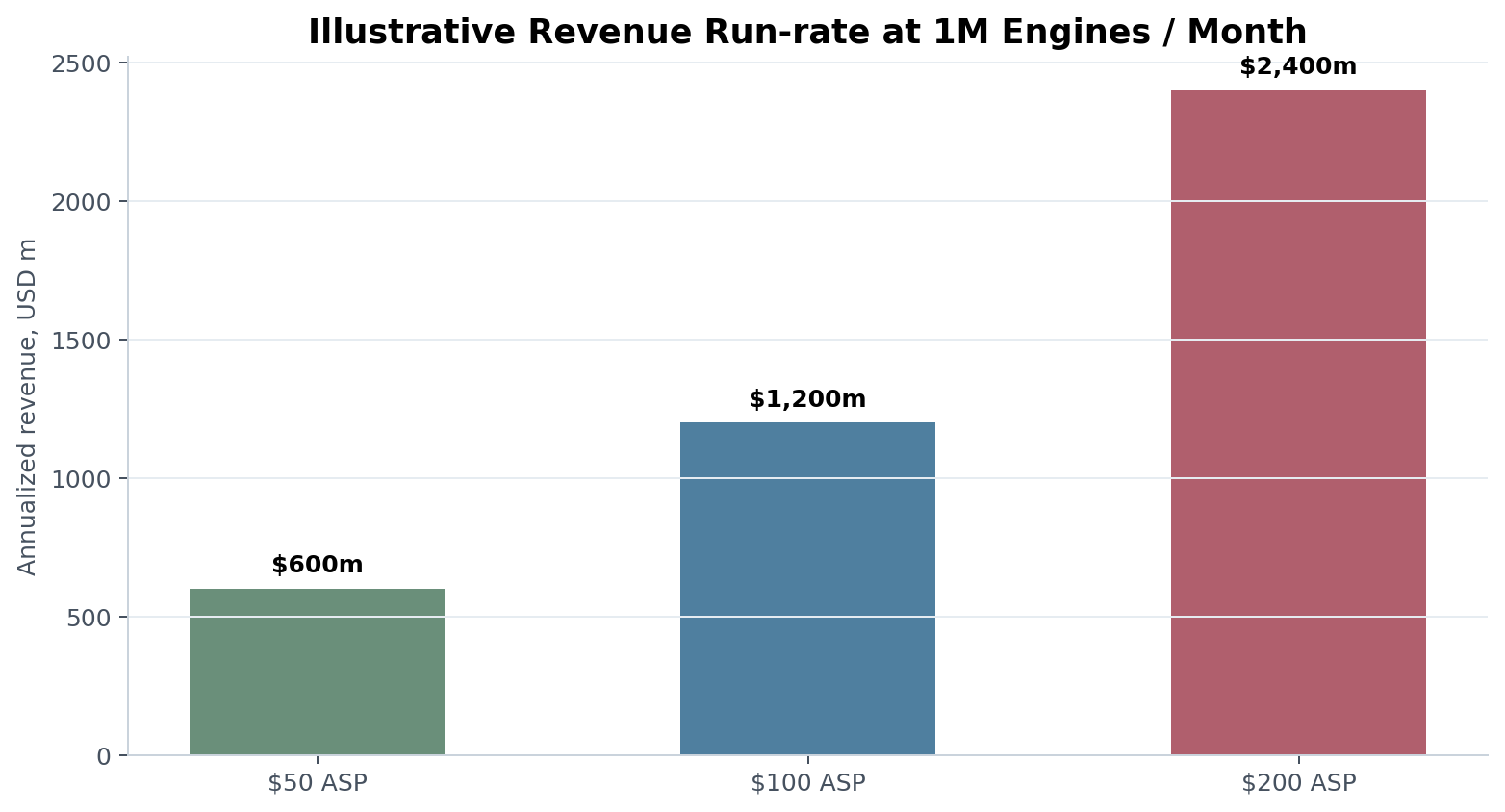
The income chart is a schematic calculation. POET has not disclosed unified optical engine ASP, and actual revenue depends on product type, customer mix, order terms, yield and lead time.
Competitor Landscape and Peer Comparison: Competitor Landscape and Peer Comparison
The advantages of POET are pure-play, small platform, and high flexibility; its shortcomings are lack of customer verifiability and mass production history. LITE/COHR is more like supply chain hard assets, AAOI's customer orders are clearer, and POET is more like the high beta option of AI optical bottleneck.
| company | core exposed | Current verifiable information | How to pronounce POET |
|---|---|---|---|
| POET | Optical interposer / optical engines / ELS | Many orders and NREs, but limited customer naming; commercialization will be verified starting from H2 2026. | It has the highest elasticity and its credibility is most dependent on subsequent disclosures. |
| Lumentum (LITE) | Lasers、optical components | The CEO said that AI demand may cause production capacity to be sold out by 2028; indicating that upstream laser is a hard bottleneck. | If LITE is in tight supply, POET's alternative/complementary architecture is more valuable. |
| Coherent (COHR) | Lasers、transceivers、materials | is a head optical supply chain representative that directly benefits from AI optical capex. | POET is smaller and earlier than COHR, and its risk-return profile is more extreme. |
| Applied Optoelectronics (AAOI) | Datacenter transceivers | Orders for next-generation 1.6T products from a large AI customer have been disclosed. | AAOI's customer verification is clearer; POET's upside relies more on Lumilens / unnamed customers turning positive. |
Financial Statement Analysis: Financial Analysis
POET's financial analysis focuses on cash, dilution, order conversion revenue, and burn rate. The cash enhancement after financing gives the company a verification window, but the stock price still needs to be recognized by revenue.
| Project | Current status | Analyze meaning |
|---|---|---|
| Revenue base | Still in early commercialization stage | Historical earnings are small and traditional P/S reference value is limited. |
| Cash / liquidity | AGM pro forma cash about USD 830m | Post-financing cash has significantly strengthened and short-term runway has improved. |
| Market cap / EV | Live market cap is about USD 576.7m; pro forma equity value is about USD 1629m | Different equity capital calibers vary greatly, and valuation should look at both the common stock market value and post-financing dilution. |
| Earnings quality | Losses and R&D investment are still the norm | The current focus is on the speed of order conversion into revenue and cash burn. |
| Dilution | Significant dilution after financing in 2026 | Cash in exchange for runway, the value of a single share depends on the subsequent earnings slope. |
Forecast Model and Operating Bridge:Forecast Model and Operating Bridge
Since the company is still in the transition period before and after mass production, this page uses operating bridge and schematic calculations, and does not use 1M engines/month as the baseline revenue assumption. The core is looking at conversion rates between orders, certifications, capacity and revenue recognition.
| stage | key assumptions | What needs to be verified |
|---|---|---|
| 2026H2 | production ramp starts | Observe whether Lumilens, ELS, systems integrator PO enters actual shipments and revenue recognition. |
| 2027 | Customer qualification and capacity expansion | If the demand is close to the 1M engines/month exit run-rate discussed by AGM, the supply chain and manufacturing end need to be amplified simultaneously. |
| 2028 | Agreement redemption period | The potential of the 500M+ five-year agreement needs to be verified by orders, shipments, revenue and customer renewals. |
Schematic calculation: 1M engines/month corresponds to 12M engines/year. The ASP in the figure is only for sensitivity display and does not represent company guidance.
Valuation: Cash Protection + Volume Production Option
POET's traditional P/S or P/E is of limited current reference significance because historical earnings are too small and future earnings depend on the 2026H2-2027 ramp. A more reasonable framework is:pro forma cash provides downside buffer, Lumilens/ELS/optical engine capacity provides upside options。
$1629m using $9.44 and 172.6m shares.
$830m cash basis from AGM/post-financing data.
$799m rough equity value less cash, excluding differences in post-financing dilution details.
| Scenario | core assumptions | Valuation meaning | Risks to watch out for |
|---|---|---|---|
| Bear | H2 2026 ramp is delayed, NRE/PO transfer revenue is slow; customer identity cannot be verified | Cash underpins valuations, but shares are priced primarily on early-stage hardware options. | Focus on burn rate and order cancellation risk. |
| Base | Lumilens and ELS projects are on 2026H2-2027 ramp; customer certification is gradually passed | 50M+ initial PO and several NRE/small PO support the revenue inflection point in 2027. | Valuation shifts from cash + technology platform to revenue multiple. |
| Bull | The demand will be close to 1 million engines/month by the end of 2027, and the path to fulfill the 500M+ five-year agreement is clear | At a 12M engines/year run-rate, even a low ASP can generate hundreds of millions of dollars in annualized revenue. | The market may revalue POET as AI optical bottleneck pure play. |
Catalysts and Monitoring Checklist: Catalysts and Monitoring Checklist
forward catalysis
- Lumilens end customers receive official confirmation or customer side verification.
- ELS's new NRE has entered into a mass production agreement and confirmed its laser supply chain partner.
- Quantifiable production ramp, revenue recognition or repeat orders appear in 2026H2.
- Head suppliers such as LITE/COHR continue to confirm that the supply of laser/optical components is tight.
negative catalysis
- Lumilens or ELS projects are delayed and PO/NRE cannot be converted into revenue.
- Customer certification fails, yield is insufficient, or the production expansion pace is lower than the AGM target.
- Laser shortage eases and POET bottleneck premium falls.
- Cash consumption after financing was too fast, and the market refocused on dilution and runway.
Follow-up checklist
| time | milestone | What needs to be verified |
|---|---|---|
| 2026H2 | Production ramp begins | Observe whether the PO is converted into actual revenue, and whether there is customer certification/mass production announcement. |
| 2026H2-2027H1 | ELS / Lumilens mass production qualification | Observe whether Sivers or other laser supplies are officially confirmed and hyperscaler clues become verifiable. |
| 2027 exit | Demand target 1M engines/month | Observe production expansion capital expenditure, yield, production line capacity and monthly delivery data. |
| 2028-2029 | Optical bottleneck persistence | If LITE/COHR supply remains tight, POET's platform value will be stronger; if the shortage eases, the valuation premium will fall back. |
key risks
Customer Transparency:Lumilens' top-3 hyperscaler clues are currently pointed to by OSINT, which has not yet been officially confirmed by POET; if there is no subsequent customer-side verification, the market will lower the quality of orders.
Mass production execution:From 1M/year to 1M/month is a completely different level of manufacturing difficulty. Yield, packaging, supply chain and acceptance will all become bottlenecks.
Laser Shortage Reversal:If LITE/COHR and others expand production faster than expected, the laser bottleneck premium will decline and the replacement value of POET will also be revalued.
Dilution and cash burn:US$830M in cash looks thick, but if investment in production expansion and R&D is large and revenue recognition is slow, equity dilution and burn rate will still affect the value per share.
Questions for Management:Management questions
- When is revenue recognition expected to begin on Lumilens' $50M+ initial PO? Is there an end customer acceptance node?
- What are the minimum purchase obligations, cancellation terms and pricing mechanisms in a $500M+ five-year commercial agreement?
- How many customers, how many product models and what application scenarios does the 2027 exit demand of 1M engines/month come from?
- What are the yield, bottleneck equipment and expansion capex of the existing 1M engines/annual production capacity?
- Can the customer identity, target power, laser supplier, and volume production schedule for ELS's new NRE be disclosed?
- How will the planned use of post-financing cash be allocated between R&D, expansion, working capital and M&A?