Company Profile
CoreWeave It is a professional cloud platform for AI workloads, providing GPU computing, managed software stack and AI infrastructure services. The company said it was founded in 2017 and listed on Nasdaq in March 2025 as CRWV CoreWeave Q1 2026 results。
Nebius Positioned as an AI cloud company, headquartered in Amsterdam, Nasdaq ticker NBIS; its products cover AI computing, inference, orchestration, storage and developer platforms Nebius / Meta agreement。
| company | what to sell | Customer and Revenue Drivers | relationship with tweets |
|---|---|---|---|
| CoreWeave / CRWV | GPU cloud, AI cluster, inference and training infrastructure, Weights & Biases related development tools. | AI labs, hyperscalers, enterprises; Q1 2026 company disclosed customers include Meta, Anthropic, Cohere, Jane Street, Mistral, etc. CoreWeave Q1 2026 results。 | Already have large-scale revenue, backlog and financing structure, it is a more mature contract redemption end. |
| Nebius / NBIS | AI cloud, Managed Inference, AI Orchestration, Compute, AI Storage, etc. | Meta five-year AI infrastructure deal starts delivery in early 2027; Q1 2026 also reveals up to 1.2GW of power and land for Pennsylvania-owned AI factory Nebius / Meta agreement Nebius Q1 2026 results。 | Contracts are more flexible, the revenue base is smaller, and value is primarily proven by deliveries beyond 2027. |
China Competitors / Chinese Substitution
The Chinese market has a strong AI cloud supply, but CRWV/NBIS, which is "overseas publicly listed, with GPU AI cloud and long-term capacity contracts for ultra-large customers as its core," is less pure. A more accurate alternative judgment should be broken down by customer location, GPU/accelerator supply, data center power, compliance and developer ecosystem.
| China related companies | replaceable part | evidence | alternative boundary |
|---|---|---|---|
| Alibaba Cloud | Public cloud, AI products, MaaS, domestic developer ecosystem. | Alibaba disclosed that the quarterly revenue of Cloud Intelligence Group in fiscal year 2026 was 41.626 billion yuan, with external revenue increasing by 40%, and AI-related product revenue accounting for 30% of cloud external revenue. Alibaba Cloud FY2026 update。 | Domestic AI cloud capabilities are strong; overseas Meta-level long-term capacity contracts, NVIDIA supply chain and US dollar financing structures do not completely overlap with CRWV/NBIS. |
| Baidu AI Cloud | AI Cloud Infra, GPU Cloud, model and application layer. | Baidu disclosed that Q1 2026 AI Cloud Infra revenue was 8.8 billion yuan, a year-on-year increase of 79%, and GPU Cloud increased by 184% year-on-year. Baidu Q1 2026 results。 | More focused on domestic AI business and model ecology; direct capacity outsourcing replacement for overseas hyperscalers is limited. |
| Tencent Cloud | Cloud services, AI-related services, and domestic and foreign enterprise cloud needs. | Tencent disclosed that Q1 2026 Business Services revenue growth was driven by cloud service revenue, including demand for AI-related services and a more favorable pricing environment Tencent Q1 2026 results。 | Tencent Cloud is a comprehensive cloud platform, and AI cloud is only a part of business services; it is difficult for the capital market to use a single AI cloud contract purity valuation. |
| Huawei Cloud | Cloud computing, AI, ICT infrastructure and domestic computing power ecosystem. | Huawei disclosed Cloud Computing revenue by business segment in 2025 of 32.161 billion yuan, including cloud computing business revenue from other segments of 72.075 billion yuan Huawei 2025 Annual Report。 | The synergy between hardware, cloud, and government and enterprise customers is strong; the comparability among overseas customers, NVIDIA GPU ecosystem, and the open market is weak. |
Conclusion: Alibaba Cloud, Baidu AI Cloud, Tencent Cloud and Huawei Cloud provide partial substitutes for China's local AI cloud demand; in terms of specific investment clues for long-term GPU capacity contracts for Meta/overseas super customers, CRWV and NBIS are still more direct public market mappings.
Executive Summary
The common point of view of CRWV/NBIS is that the shortage of AI computing supply has transformed "cloud vendors' self-built capex" into "long-term capacity procurement contracts". Neocloud vendors can use contract visibility to leverage debt, equity and data center resources. Both companies are assets with high volatility and high execution requirements; current valuations have already reflected significant growth expectations, and the main variables for subsequent stock prices are capacity delivery speed, contract revenue recognition, financing costs and customer concentration.
| Project | CRWV | NBIS | judge |
|---|---|---|---|
| Investment conclusion | It's more positive, with a higher degree of redemption but heavy leverage. | Slanted to the positive, with higher resilience but more concentrated delivery risk in 2027. | The combination looks more like AI infrastructure beta; CRWV looks more like certainty when looked at individually, and NBIS looks more like options. |
| contract visibility | Q1 2026 revenue backlog is US$99.4 billion, and Meta has disclosed a new commitment of US$21 billion CoreWeave Q1 2026 results。 | Meta five-year contract of up to approximately $27 billion, with $12 billion of dedicated capacity, to be delivered from early 2027 Nebius / Meta agreement。 | The contract is the real anchor, but revenue recognition relies on capacity coming online. |
| financial constraints | Q1 2026 revenue $2.078 billion, adjusted EBITDA $1.157 billion, net loss $740 million CoreWeave Q1 2026 results。 | Q1 2026 revenue $399 million, adjusted EBITDA $129.5 million; GAAP net profit affected by investment revaluation gains Nebius Q1 2026 SEC exhibit。 | Both have EBITDA, but free cash flow is suppressed by asset-heavy expansion. |
| core tracking | Active power, contracted power, debt maturity, Meta/Anthropic and other customers are concentrated. | Pennsylvania AI factory, Vera Rubin deployment, Meta dedicated capacity online, non-Meta customers. | Subsequent quarters should look at megawatt to revenue conversion efficiency. |
Key Takeaways
- The contract size of more than US$48 billion in the tweet can generally be supported by official disclosures, but the precise caliber needs to be broken down: CoreWeave Meta disclosed a total of approximately US$35.2 billion, and the Nebius Meta contract is up to approximately US$27 billion, of which US$12 billion is dedicated capacity. CoreWeave Q3 2025 results CoreWeave Q1 2026 results Nebius / Meta agreement。
- The advantage of CRWV is that it already has a large revenue base and a backlog of US$99.4 billion; the disadvantage is that capital expenditures, debt and customer concentration are simultaneously amplified CoreWeave Q1 2026 results。
- The advantage of NBIS is that the Meta contract is huge relative to current revenue, and the total cash and restricted cash at the end of Q1 2026 is US$9.6269 billion; the disadvantage is that revenue recognition is more dependent on capacity delivery after 2027 Nebius Q1 2026 SEC exhibit。
- Chinese substitution mainly exists in the domestic AI cloud and domestic computing power ecosystem, and it is difficult to completely map to the GPU capacity outsourcing contract of Meta/overseas hyperscaler.
- Valuation tolerance comes from two directions: AI inference demand continues to accelerate and will support high multiples; if GPU rental prices, customer self-build speeds, or the financing environment weaken, high contract amounts may also translate into low shareholder returns.
Recent Two-Year Share Price Trend
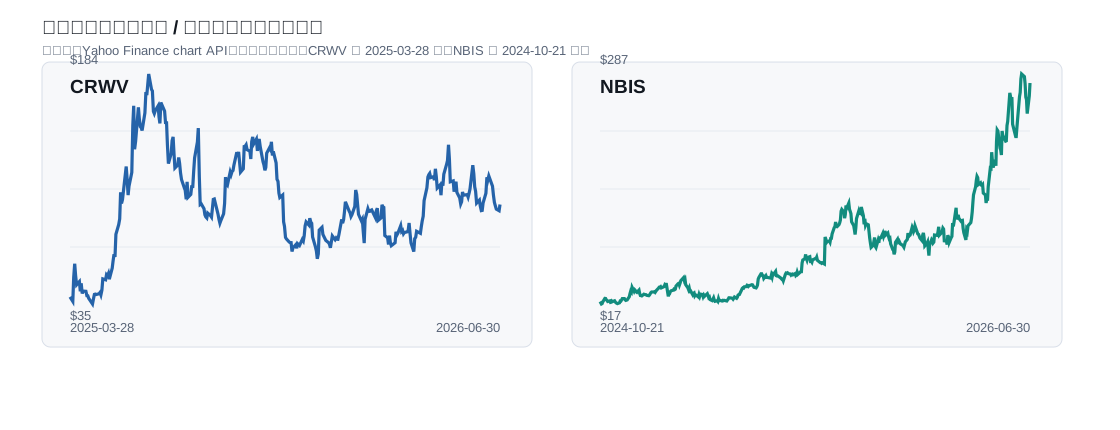
| Ticker | starting point | end point | range high | range low | Range rise and fall |
|---|---|---|---|---|---|
| CRWV | 2025-03-28 / $40.00 | 2026-06-30 / $99.54 | 2025-06-20 / $183.58 | 2025-04-21 / $35.42 | +148.9% |
| NBIS | 2024-10-21 / $20.00 | 2026-06-30 / $276.17 | 2026-06-18 / $286.69 | 2024-10-23 / $17.16 | +1280.9% |
Stock prices have been significantly revalued, and NBIS has seen particularly high gains, indicating that the market has factored in expectations for Meta contracts, AI cloud scarcity, and financing capabilities. For new funds, subsequent judgment should not only look at the contract headline, but also whether the contract can be converted into available capacity and sustainable EBITDA at a reasonable capital cost.
Market / Industry Context
The bottlenecks of AI infrastructure come from four layers: high-end GPU/accelerator supply, data center power supply, network and storage, and software stack for large model training and inference. The value of CRWV and NBIS is in packaging these constraints into deliverable cloud capacity, without customers having to wait entirely to build their own data centers.
| drive | Impact on CRWV/NBIS | Counter-evidence that needs to be verified |
|---|---|---|
| Hyperscaler self-build cycle is long | Short-term capacity gaps increase outsourced AI cloud value. | Meta, Google, Microsoft, Amazon, etc. built their own projects significantly faster than expected, and the growth rate of outsourcing contracts slowed down. |
| Expansion of reasoning needs | CoreWeave said that the market has shifted from training to inference, and products such as Dedicated Inference serve the production environment. CoreWeave Q1 2026 results。 | Inference costs are falling rapidly, putting unit GPU revenue and rental prices under pressure. |
| Power and data centers have become scarce resources | CoreWeave Q1 2026 disclosed active power exceeding 1GW and contracted power exceeding 3.5GW CoreWeave Q1 2026 results; Nebius reveals up to 1.2GW of power and land for Pennsylvania projects Nebius Q1 2026 results。 | Delays in grid access, permitting, construction or supply chains lead to stretched capacity-to-revenue. |
| Contract Support Financing | Long-term customer commitments increase project financing visibility. | Changes in interest rates, debt markets, or customer credit terms result in shareholder dilution or lower project returns. |
Company / Segment Quality
| Dimensions | CoreWeave | Nebius |
|---|---|---|
| Business Purity | AI cloud accounts for a high proportion of revenue and has formed a large-scale platform and customer base. | AI cloud has high purity, small current revenue volume, and stronger contract-driven flexibility. |
| revenue visibility | Revenue backlog reaches US$99.4 billion, with customers covering AI Labs, hyperscalers, and enterprises CoreWeave Q1 2026 results。 | Meta contracts are worth up to approximately $27 billion, with deliveries starting in early 2027 Nebius / Meta agreement。 |
| capital intensity | Q1 2026 cash flow from investments such as property and equipment is US$7.695 billion, operating cash flow is US$2.984 billion CoreWeave Q1 2026 results。 | Q1 2026 Purchased property/equipment/intangibles $2.4729 billion, operating cash flow $2.258 billion Nebius Q1 2026 SEC exhibit。 |
| financing position | Q1 2026 Discloses $8.5 billion DDTL 4.0 facility and $2 billion common stock investment in NVIDIA CoreWeave Q1 2026 results。 | The total cash and restricted cash at the end of Q1 2026 was US$9.6269 billion, and there was an inflow of convertible bonds and prefunded warrants financing in the quarter Nebius Q1 2026 SEC exhibit。 |
The watershed in business quality is unit capacity economics: customer contract amounts, GPU costs, data center capex, electricity bills, depreciation and financing costs collectively determine shareholder returns. CRWV has entered the large-scale verification period; NBIS is still in the early stages of converting large contracts into large revenue.
Orders / Customers / Partnerships
| event | Disclosure | Analyze meaning |
|---|---|---|
| CoreWeave / Meta 2025 | CoreWeave reveals long-term deal with Meta worth up to approximately $14.2 billion CoreWeave Q3 2025 results。 | It proves that Meta has outsourced AI cloud capacity to CRWV, and the contract size is enough to affect the backlog. |
| CoreWeave / Meta 2026 | Q1 2026 reveals multiple new agreements with Meta, including $21 billion in new commitments signed in March CoreWeave Q1 2026 results。 | Meta's demand for CRWV is still expanding, and the core read-through of tweets has official support. |
| Nebius / Meta 2026 | Nebius reveals five-year contract for $12 billion in dedicated capacity, with up to $15 billion in additional capacity, for a total contract value of up to approximately $27 billion Nebius / Meta agreement。 | NBIS's market capitalization elasticity comes from the large gap between contracts and the current revenue base. |
| NVIDIA Ecosystem | CoreWeave discloses acquisition of NVIDIA Exemplar Cloud for inference on NVIDIA GB200 NVL72 and receipt of $2 billion common stock investment from NVIDIA CoreWeave Q1 2026 results。 | The GPU supply chain and customer trust have increased, but it has also increased reliance on NVIDIA platform rhythm. |
Competitors / Peer Comparison
CRWV has few public market comparables to NBIS. Large hyperscalers have cloud infrastructure but their businesses are too comprehensive; AI cloud companies such as Lambda and Crusoe have limited public financial information; IREN, Core Scientific and others are more focused on data center/computing power transformation, and their customers and business models are quite different.
| Company type | represent | Advantages | limitations |
|---|---|---|---|
| Professional AI Cloud | CoreWeave、Nebius、Lambda、Crusoe | Business purity is high, with customer contracts and GPU capacity directly driving valuations. | Capital expenditures and financing dependence are high, and customer concentration risks are obvious. |
| Comprehensive hyperscaler | Microsoft Azure、Google Cloud、AWS、Oracle Cloud | Strong customers, funds, network and global regions. | The stock does not offer pure AI cloud capacity beta and may go from being a CRWV/NBIS customer to a competitor. |
| Data center/computing platform | IREN, Core Scientific, etc. | Power and site resources can be migrated to the AI workload. | The software stack, customer contracts, GPU supply and AI cloud service capabilities need to be gradually verified. |
| China Cloud Platform | Alibaba Cloud, Baidu AI Cloud, Tencent Cloud, Huawei Cloud | Strong domestic model and corporate customer ecosystem. | Weak direct mapping to Meta/overseas hyperscaler contract chain. |
Financial Statements
Revenue and Profit Quality
| indicator | CRWV Q1 2026 | NBIS Q1 2026 | Interpretation |
|---|---|---|---|
| Revenue | US$2.078 billion, compared with US$982 million for the same period in 2025 CoreWeave Q1 2026 results。 | US$399 million, US$50.9 million for the same period in 2025 Nebius Q1 2026 SEC exhibit。 | Both companies are growing rapidly; NBIS has a small base and its growth rate is more likely to be amplified by large contracts. |
| Adjusted EBITDA | US$1.157 billion, margin 56% CoreWeave Q1 2026 results。 | $129.5 million Nebius Q1 2026 SEC exhibit。 | EBITDA is already positive, but depreciation, interest and capex are still key to cash returns to shareholders. |
| GAAP net income/loss | Net loss $740 million CoreWeave Q1 2026 results。 | Net profit of $621.2 million, but including equity securities revaluation gain of $780.6 million Nebius Q1 2026 SEC exhibit。 | NBIS's GAAP earnings are affected by the revaluation of investments, and operating losses still need to be looked at separately. |
| operating cash flow | $2.984 billion CoreWeave Q1 2026 results。 | USD 2.258 billion, of which the increase in deferred revenue of USD 3.198 billion was an important contribution Nebius Q1 2026 SEC exhibit。 | Prepaid/deferred revenue improves cash flow, but revenue recognition is still dependent on performance. |
Assets, liabilities and capital intensity
| indicator | CRWV | NBIS |
|---|---|---|
| Cash and restricted cash | Cash at the end of Q1 2026 was US$2.244 billion, and the total cash and restricted cash at the end of the period was US$3.320 billion. CoreWeave Q1 2026 results。 | Cash at the end of Q1 2026 was US$9.2982 billion, and cash and restricted cash totaled US$9.6269 billion Nebius Q1 2026 SEC exhibit。 |
| Debt | current debt $7.547 billion, non-current debt $17.312 billion CoreWeave Q1 2026 results。 | current debt US$18.4 million, non-current debt US$8.432 billion Nebius Q1 2026 SEC exhibit。 |
| Fixed assets/investments | property and equipment net USD 36.424 billion; Q1 purchase of property/equipment, etc. USD 7.695 billion CoreWeave Q1 2026 results。 | property and equipment $7.1317 billion; Q1 purchases of property/equipment/intangibles $2.4729 billion Nebius Q1 2026 SEC exhibit。 |
Forecast / Operating Bridge
This type of company doesn't lend itself to just plain old SaaS revenue multiples. A more reliable bridge is: contract value -> available power and GPU -> delivered capacity -> revenue recognition -> EBITDA -> shareholder cash flow after deducting maintenance capex, interest and refinancing costs.
| bridging link | CRWV requires proof | NBIS requires certification |
|---|---|---|
| contract to capacity | Active power has exceeded 1GW, and contracted power has exceeded 3.5GW; the follow-up depends on the 8GW target path and project financing CoreWeave Q1 2026 results。 | Meta Vera Rubin capacity to start delivery in early 2027, Pennsylvania project up to 1.2GW; key lies in construction progress and GPU arrival Nebius / Meta agreement Nebius Q1 2026 results。 |
| capacity to revenue | Backlog to revenue velocity, customer availability requirements and SLAs are core. | How revenue is recognized for Meta's dedicated capacity and additional capacity will need to be disclosed in subsequent quarters. |
| Revenue to EBITDA | Adjusted EBITDA margin is currently high, but depreciation and interest eat into GAAP earnings. | The current adjusted EBITDA has turned positive, and the cost structure needs to be verified after the scale is expanded. |
| EBITDA to shareholder return | High capex and debt rollover are the main constraints. | Cash thickness is good, but big projects will consume capital quickly. |
Indicative baseline: If AI inference demand continues to be higher than self-built supply, the probability of contract renewal and capacity expansion will increase; if the customer's self-built pace accelerates or GPU rental prices fall, contract visibility may also be offset by lower capital returns.
Valuation / Scenarios
The following are indicative calculations based on disclosed Q1 2026 financials and 2026-06-30 closing prices, and cannot be equated to company guidance. CRWV uses the Q1 weighted average share count of 527 million shares, and NBIS uses the Q1 diluted share count of 308.97 million shares as a broad reference; actual fully diluted share capital, convertible bonds and subsequent financing will change the results CoreWeave Q1 2026 results Nebius Q1 2026 SEC exhibit Yahoo Finance CRWV chart API Yahoo Finance NBIS chart API。
| Scenario | CRWV | NBIS | meaning |
|---|---|---|---|
| conservative | Backlog revenue transition is slower than market expectations, capex continues to lead revenue, and EV/EBITDA multiples are compressed. | The Meta project is delayed or the additional capacity is lower than expected, and the current revenue multiple is difficult to support. | Share prices are sensitive to execution delays and financing conditions. |
| benchmark | Customers such as Meta and Anthropic drive revenue to continue to expand. EBITDA is high but free cash flow is under periodic pressure. | Meta’s dedicated capacity will come online in 2027, and cash reserves will support construction. | Valuation relies on investors being willing to pay high multiples for future capacity. |
| optimistic | The transformation between active power and contracted power is smooth, customer expansion and new customer concentration are reduced. | Third-party customers other than Meta absorb additional capacity, and NBIS shifts from option-based assets to scale-based AI cloud. | High contract visibility coupled with supply shortages can continue to support premium prices. |
Looking at simple multiples, NBIS's current valuation is more expensive relative to existing revenue, and the market is paying for the option value of the contract after 2027; CRWV's revenue and EBITDA base are larger, but net debt, depreciation and interest make the safety margin of common stocks not thick.
Catalysts / Monitoring Checklist
- New/expansion contracts for Meta, Anthropic, and other AI labs or enterprises.
- Quarterly changes in CRWV active power, contracted power, data center count and backlog.
- NBIS Pennsylvania AI factory, Vera Rubin deployment, early 2027 Meta capacity delivery node.
- GPU supply, NVIDIA platform iteration, Vera Rubin/GB200/NVL72 and other online progress.
- Whether the gap between deferred revenue, customer advances, operating cash flow and capex continues to widen.
- Debt financing rates, convertible debt dilution, equity financing, NVIDIA or other strategic capital participation.
Risks
- Customer Concentration: The larger the Meta contract, the greater the impact of a single customer’s budget, project pace and bargaining power on the valuation.
- Construction and Power: Data center permitting, grid access, cooling, power procurement and construction delays can delay revenue recognition.
- GPUs and platform iterations: Delays in next-generation NVIDIA platform delivery or changes in unit economics can impact capacity costs.
- Price risk: If AI cloud leasing prices drop rapidly, high contract amounts may also correspond to lower returns.
- Financial leverage: CRWV has high debt and capital expenditures; large NBIS projects will also continue to consume cash.
- Accounting quality: NBIS Q1 GAAP earnings include revaluation gains, and CRWV adjusted EBITDA is no substitute for free cash flow.
- Competition: Customer self-build, integrated hyperscaler price reductions, and other AI cloud financing expansions will all reduce scarcity premiums.
Questions For Management
- How are fixed capacity, variable capacity, service availability and revenue recognition cadence separated in Meta contracts?
- What are the MW, number of GPUs and corresponding capex range that each company can bring online in the next eight quarters?
- How do the conversion rates of customer advances, deferred revenue, and backlog change?
- How will unit GPU revenue, utilization, and gross margin change when the proportion of inference workloads increases?
- What is the proportion of fixed-rate, floating-rate, convertible bonds and project-level debt in the financing structure?
- Can customers outside of Meta absorb additional capacity, reducing single customer risk?
- If delivery of NVIDIA's new platform is delayed, what alternative hardware or contractual protections does the company have?
Social Thesis
Original tweet:https://x.com/aleabitoreddit/status/2072314906729455876 Original X tweet
The investment implication of this tweet is this: If Meta and other hyperscale cloud players remain constrained by AI computing resources, the market's simplistic narrative of Meta's capex downward revision as "overbuilding" may underestimate the need for outsourced AI cloud capacity. The tweet named $CRWV and $NBIS. The core benefit chain is that Meta will hand over the short-term capacity gap to Neocloud vendors, and the vendors will use long-term contracts to support financing and data center expansion.
This page uses tweets as demand-side clues and official contracts, financial statements and market data as the basis for conclusions. Customer allocations, short-term capex rumors and trading motivations in social media that cannot be independently verified are treated only as variables to be verified.