Company Profile
AXT, Inc. is a Nasdaq-listed materials company that develops and manufactures compound and single-element semiconductor substrate wafers: indium phosphide, gallium arsenide, and germanium company description. These wafers are used where silicon substrates cannot meet device performance requirements 2025 10-K.
AXT is legally a Delaware corporation with headquarters in Fremont, California, while its Asia headquarters and manufacturing facilities are in China Q1 2026 release. Its supply chain includes partial ownership in more than ten China raw-material companies, which gives raw-material visibility but creates China operating and policy exposure 2025 10-K.
| Business line | 2025 revenue | Quality read |
|---|---|---|
| Substrates | $58.9m | Core strategic line; includes InP, GaAs and Ge substrates 10-K product table. |
| Raw materials and others | $29.4m | Supports substrate economics and supply visibility, but is not the main AI optics thesis 10-K product table. |
| Total | $88.3m | Small base relative to a multi-billion-dollar market cap, so valuation depends on a steep ramp 10-K product table. |
China Alternatives
AXT is not a Chinese-listed target, but its production base and Tongmei subsidiary are in China. The practical substitution question is therefore not whether China can replace an offshore factory; it is whether independent Chinese suppliers can replace AXT/Tongmei's qualified InP and GaAs output for the same customers.
| Company / source | Overlap with AXTI | Evidence quality | Substitution judgment |
|---|---|---|---|
| Yunnan Germanium / Xinyao Semiconductor | 2025 annual filing says the company has GaAs wafers and InP wafers, with InP capacity of 150k wafers per year on a 2-4 inch basis 2025 annual filing page. | Official Chinese filing page. | Meaningful China substitute in InP, but public data does not prove the same international customer qualification breadth as AXT. |
| Yunnan Germanium expansion | April 2026 announcement says Xinyao plans RMB 188.56m of investment and targets 450k 4-inch-equivalent annual InP wafer capacity after adding a 300k line including 6,000 6-inch wafers expansion announcement. | Official Chinese announcement page via Sina disclosure mirror. | Capacity response is real; execution, yield and customer qualification remain the watch items. |
| GRINM, San'an, Shaanxi Injay | TrendForce lists these Chinese companies as promoting InP localization alongside Yunnan Germanium TrendForce. | Reputable industry secondary source. | Segment-level substitutes; not enough public proof for full replacement of AXT's global substrate role. |
Conclusion: China has segment-level substitutes and a credible domestic ramp, especially through Yunnan Germanium/Xinyao. A full replacement for AXT's global qualified supply position is not proven by public filings.
Executive Summary
View: conditional positive. The strongest part of the thesis is that AXT has a scarce asset in InP substrates, a capital raise to expand Tongmei capacity, and improving Q1 margins. The weak part is valuation: the stock already moved from a micro-cap base to a multi-billion-dollar equity value, and the company still reported only $26.9m of Q1 revenue and a GAAP net loss Q1 2026 results.
| Metric | Current read | Source / caveat |
|---|---|---|
| View | Conditional positive | Pricing and InP permits must convert into sustained revenue. |
| Last price | $53.91 | 2026-07-02 close from Yahoo chart API. |
| Market cap | ~$3.5bn | Calculated from 65,423,184 shares outstanding as of May 4, 2026 10-Q. |
| Pro forma cash / investments | ~$708m | Q1 cash plus short-term investments and illustrative net offering proceeds 10-Q 424B5. |
| Next proof point | Q2/Q3 revenue and permit cadence | Management framed capacity and customer planning as central to demand conversion Q1 2026 release. |
Using the latest chart close and the 10-Q share count, market cap is about $3.5bn. After adding illustrative net proceeds from the April 2026 offering to Q1 cash and short-term investments, enterprise value is roughly $2.9bn. That leaves little room for an ordinary recovery; the market is paying for a major InP ramp.
Key Takeaways
- The business has a real scarcity angle: management says InP substrates are a key ingredient for high-speed optical data transmission in AI-focused data centers Q1 2026 release.
- The balance sheet changed materially: AXT said it completed a $632.5m capital raise supporting Tongmei InP expansion and 6-inch InP R&D Q1 2026 release.
- Dilution is not incidental. The April 2026 prospectus sold 8.56m shares at $64.25, with an option for 1.284m additional shares 424B5.
- Permits are a hard gate. AXT says China InP export permits remain uncertain and beyond its control 10-Q.
- The clean thesis is not simply 'InP shortage'. It is 'shortage plus permit approvals plus customer qualification plus yield plus price realization'.
Two-Year Share Price
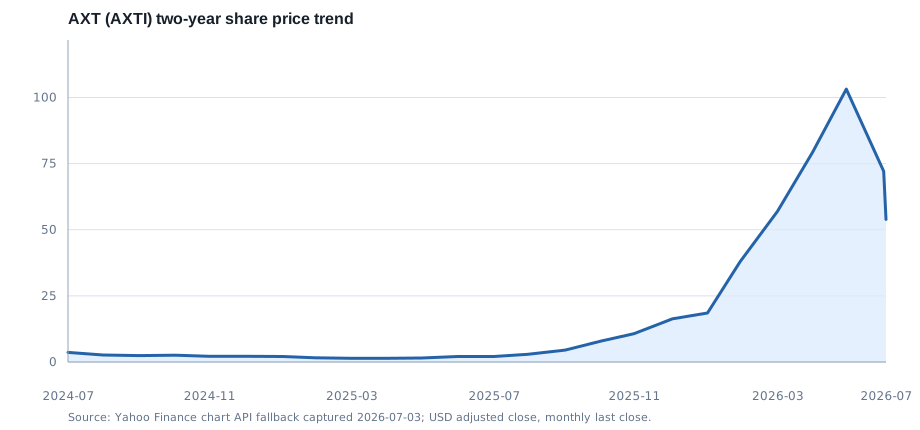
AXTI rose from $3.64 in July 2024 to $53.91 on July 2, 2026, with a 52-week high reported by Yahoo at $143.16. The chart supports Serenity's caution on dilution and volatility: even after a pullback from the high, the stock still embeds a large future ramp.
Market Context
InP is relevant because high-speed photonic devices use light rather than only electrical signaling. TrendForce describes InP as important for optical communications, quantum-dot displays, and space photovoltaics, and says the global InP industry is concentrated in Japan, the United States, and China TrendForce.
Coherent's note on 6-inch InP explains the economic direction of the industry: larger wafers can increase device count per wafer and lower die cost, with Coherent citing greater than 60% die-cost reduction from its 6-inch transition Coherent. AXT's own R&D emphasis on 6-inch InP therefore matches the industry's cost-scaling vector, but it still has to prove yield and qualification.
Company / Segment Quality
| Quality factor | Positive evidence | Counterweight |
|---|---|---|
| Substrate know-how | AXT operates one segment focused on high-performance compound and single-element semiconductor substrates 10-K segment note. | The company does not disclose granular InP margin or customer concentration by product in enough detail to model pricing power cleanly. |
| Vertical raw-material model | AXT says its partial ownership in China raw-material companies provides reliable supply, market trend visibility, and shorter lead times 10-K. | The same China supply chain creates regulatory, tariff and permit risk. |
| Capacity funding | The April 2026 raise directly funds Tongmei InP capacity and R&D offering announcement. | Equity holders absorb dilution before the capacity payoff is visible. |
Orders / Customers / Partnerships
AXT does not publicly identify enough end customers to underwrite a customer-by-customer backlog model. Management did state in Q4 2025 results that it was broadening its customer base to Tier-1 companies and was on track to double InP manufacturing capacity in 2026 FY2025 results. Treat that as management commentary, not as a signed-contract disclosure.
Customer proof points to watch are: export permits by destination, named qualification wins, 6-inch InP sample acceptance, and whether data-center related InP revenue grows faster than total revenue.
Competitors
| Peer | Position | Read-through for AXTI |
|---|---|---|
| Sumitomo Electric | TrendForce describes Sumitomo Electric as the global InP substrate leader with 2-6 inch substrate capability TrendForce. | Sets the quality and scale bar for AXT. |
| JX Advanced Metals / other Japan players | TrendForce says global leadership remains with international players with long accumulated expertise TrendForce. | AXT's scarcity value depends on whether capacity outside Japan remains constrained. |
| Coherent | Coherent has announced 6-inch InP scalable wafer fabs and cites capacity and die-cost advantages Coherent. | A competing internal/supplier route for photonic device makers; relevant to AXT's pricing duration. |
| Yunnan Germanium / Xinyao | Official Chinese disclosure shows InP capacity and expansion plans annual filing expansion. | China domestic substitute risk over time, especially for local customers. |
Financial Statements
| Metric | Latest / period | Interpretation |
|---|---|---|
| Q1 2026 revenue | $26.9m, up from $19.4m in Q1 2025 Q1 release. | Growth is visible but still small against valuation. |
| Q1 2026 GAAP gross margin | 29.6%, compared with -6.4% in Q1 2025 Q1 release. | Margin recovery is the best financial evidence for operating leverage. |
| Q1 2026 GAAP net loss | $1.6m loss attributable to AXT, or $0.03 per share Q1 release. | Near breakeven, but not yet high-return growth. |
| Cash + short-term investments | $107.1m at March 31, 2026 before the April equity raise 10-Q balance sheet. | The balance sheet was then transformed by the offering. |
| Inventory | $90.2m at March 31, 2026 10-Q. | High inventory can help meet demand, but also creates write-down risk if permits or demand slip. |
Forecast / Operating Bridge
| Driver | Base assumption | What would change the case |
|---|---|---|
| InP volume | Capacity expansion lifts shipments over 2026-2028. | Bear case if export permits remain uneven; bull case if customer schedules and permits align. |
| Pricing | Some price realization as supply remains tight. | Bull case needs clear ASP/margin evidence; bear case if China substitutes cap price. |
| Gross margin | Moves from recovery into sustained 30%+ range. | Needs yield and utilization; raw-material inflation can offset price hikes. |
| Dilution | April 2026 funding is enough to support near-term expansion. | Further raises would weaken per-share upside. |
Valuation / Scenarios
At roughly $2.9bn of illustrative EV, AXTI trades around 26-27x Q1 2026 annualized revenue. That is not a normal substrate-company multiple; it prices in a scarcity-cycle ramp. The valuation can work only if revenue expands several-fold with durable gross margin.
| Scenario | Revenue / margin shape | Valuation read |
|---|---|---|
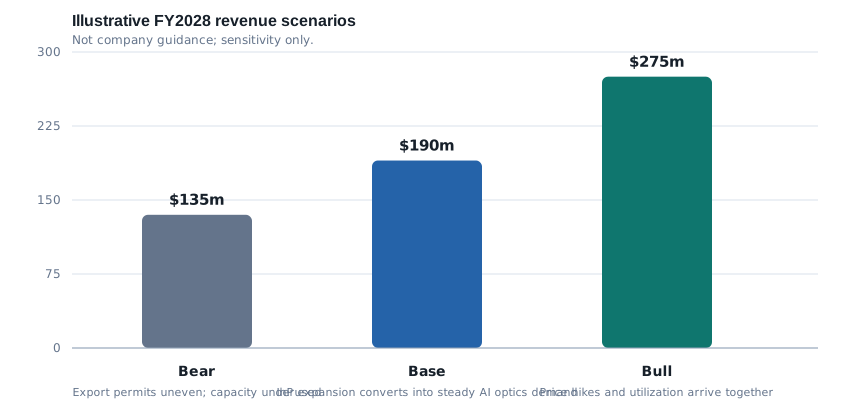
| Bear | $125-150m revenue, permit delays, gross margin below 30%. | Equity value is vulnerable because current EV already discounts more than recovery. |
| Base | $175-225m revenue by FY2028, gross margin low-to-mid 30s, controlled opex. | Upside depends on investors assigning scarcity multiples after dilution. |
| Bull | $275m+ revenue with visible 6-inch InP adoption and durable price hikes. | This is the path where Serenity's 'undervalued if price hikes are weaponized' can be defended. |
Catalysts
- Q2/Q3 2026 earnings: revenue cadence and InP commentary Q1 release.
- Export-permit updates from China, because InP permits are described as a major concern 10-Q.
- 6-inch InP R&D and qualification milestones.
- Tongmei STAR Market approval or further delay.
- Customer or supply-chain disclosures that name optical module, laser, or hyperscale-related qualification.
Risks
- Permit and trade-policy risk: AXT says timing for permits is uncertain and beyond its control 10-Q.
- Valuation risk: the 10-Q warns the stock price may fluctuate dramatically and decline rapidly regardless of business developments 10-Q.
- Dilution risk: the April 2026 financing materially expanded the share count 424B5.
- Execution risk: AXT says tier-one customers require very high substrate quality and difficult specifications 10-Q.
- Substitution risk: Yunnan Germanium/Xinyao's capacity expansion shows China-local InP supply is moving expansion announcement.
Management Questions
- What percentage of 2026-2027 planned InP capacity is already covered by customer forecasts, take-or-pay commitments, or purchase orders?
- How much of the April 2026 capital raise is tied to 6-inch InP versus 2-4 inch capacity?
- What is the current export-permit approval rate by region, and what lead time should customers assume?
- What gross-margin range is realistic when new capacity ramps but depreciation and training costs rise?
- How many tier-one customers have completed qualification for new InP capacity?
- What conditions would cause management to raise equity again?
Sources and Assumptions
All valuation figures are illustrative calculations from public filings and market data. They are not company guidance. Social-media wording is treated as a thesis prompt, not as factual evidence.
Social Thesis
Original X/Twitter thesis: Serenity reply on AXTI. The reply is readable in a public mirror and is not a subscriber-only post fxtwitter mirror.
The social logic is compact: AXTI has already diluted shareholders during a sharp share-price move, but the author still sees conditional undervaluation if AXT can use tight InP supply to push price. The “if” matters. The public evidence supports a real InP capacity and export-permit bottleneck; it does not yet prove that AXT can sustainably raise price, hold share, and lift margins at the same time.